




Montserrat Monastery – The Accounting of Heaven

34 Montserrat Monastery – The Accounting of Heaven We need to talk about parking ticket machines for a second. There are those days in vanlife when everything goes like clockwork. And then there are Tuesdays at the foot of Montserrat. I was standing in front of the barrier to the day-use parking lot in my yellow postal van, the line behind me was growing impatient, and the bulky metal monster of a pay station steadfastly refused to accept my credit card. “Card invalid,” flashed the pixelated display. I sighed. “Come on, pal. I just want to park under these jagged rocks for a few hours, stretch my legs, and maybe figure out why people have been pilgriming up this mountain for a thousand years.” I slapped the flat of my hand against the metal side panel. A hollow clang echoed through the cool mountain air. I gave the machine a bit of a shake by the card slot—just the usual, expert persuasion tactic every driver knows by heart. A nasty, high-pitched hum kicked in. The display started flickering wildly, throwing out hieroglyphs followed by an error message that was definitely not written in Spanish or Catalan: “Error 0x880: Temporal Loop Activated.” “What the…?” Before I could finish the thought, reality snapped shut like an old rubber band. The chug of my van’s diesel engine went silent. The smell of exhaust fumes and damp pine needles was abruptly replaced by the pungent stench of unwashed wool, cold candle wax, and very old cheese. I blinked. The parking lot was gone. My postal van was gone. I was no longer standing in front of a parking barrier, but right in the middle of a drafty, gloomy room with thick stone walls. Seated before me at a massive oak table were three men, illuminated by the meager glow of two smoking tallow candles. They were dressed in heavy cloth and long robes, staring at me in complete shock. “Where… where’s the scanner slot?” I stammered, pulling my blue cap low over my face as I tried to process the situation rationally. Perhaps that wasn’t cinnamon in my morning oatmeal, but hallucinogenic mushrooms. Or maybe the Catalan heat had finally fried my brain once and for all. “Who are you, stranger?” called out the man in the middle. He wore a slightly lopsided bishop’s miter and held a half-eaten chicken leg like a scepter. “And what is that strange blue headpiece? Is that some sort of heresy from Zaragoza?” “I… I just wanted to pay ten euros,” I said cautiously. “Ten euros?” chimed in the man to his left. He was as thin as a dried prune and sat behind a rather modest pile of silver coins. “What is a euro? Does that sound like hard currency? If so, hand it over! The Diocese of Manresa is broke!” I blinked again. Manresa? Broke? Bishop? The bishop sighed deeply, forgot about me for a moment, and gestured dramatically with the chicken bone in the air. “We have a hole in our budget bigger than the gorges of that blasted mountain behind us! The peasants pay their tithes in rancid butter, the merchants bypass our toll bridges, and the Pope is threatening to strip my miter if we don’t fix the cathedral roof soon. Berenguer, tell me we still have gold!” The thin man—obviously the Minister of Finance—shook his head mournfully and flicked the small wooden chest in front of him. It gave off a depressingly hollow sound. “Nothing, Your Eminence. Unless we conjure up a miracle within the next month, we’ll have to run the Mass on a shoestring budget and dilute the communion wine.” “A miracle…” muttered the third man in the group. He had well-groomed hands, a clever glint in his eye, and was unrolling a sheet of parchment. He was, without a doubt, the medieval PR manager. “We don’t need a small miracle. A healing spring won’t get any peasant to part with their coin these days. People want the whole package: lights, music, untouchable mysticism!” I leaned carefully against the cold stone wall. Okay, pep talk to my brain: Either you just collapsed on the asphalt and are dreaming the biggest nonsense of your life, or you are witnessing the birth of one of Europe’s greatest legends. “Listen here,” the PR specialist said, snapping his fingers with enthusiasm. “We take a few shepherd kids. They’ll believe anything if you promise them a loaf of bread. We send them to the foot of Montserrat on a Saturday evening. We hide a few men in the bushes to wave torches and play the flute.” “Flute?” the bishop asked skeptically. “You think that will convince the masses?” “Angelic singing, Your Eminence!” the PR man corrected with a broad grin. “We’ll call it heavenly melodies. The kids will run to the village, raving about the light and the voices. The following Saturday, you, the Bishop of Manresa, show up in full regalia. We pretend to find a carved statue of the Virgin Mary in a cave.” The Finance Minister perked up. His eyes turned greedy. “And then? How do we monetize that?” “Simple, Berenguer! We act as if we’re going to carry the statue to Manresa. But after just ten yards, you stop, contort your face in pain, and cry out: ‘Alas! She has grown as heavy as the mountain itself!’ We claim the Holy Virgin refuses to leave Montserrat. She WANTS to stay right here!” The bishop slammed his fist onto the table so hard the candles wobbled. “Brilliant! If the statue won’t come to the faithful, the faithful must come to the statue! We’ll build a chapel! No, a monastery! We’ll charge road tolls, sell devotional items, burn candles for cash, and later we’ll even get the city of Florence to pay for the lamp oil!” “Brilliant,” whispered the Finance Minister, tears of emotion welling up in his eyes. “It will fill the treasury for centuries! A marketing masterpiece!” They grinned at
Lleida – The Shadow Over the Porta dels Apòstols
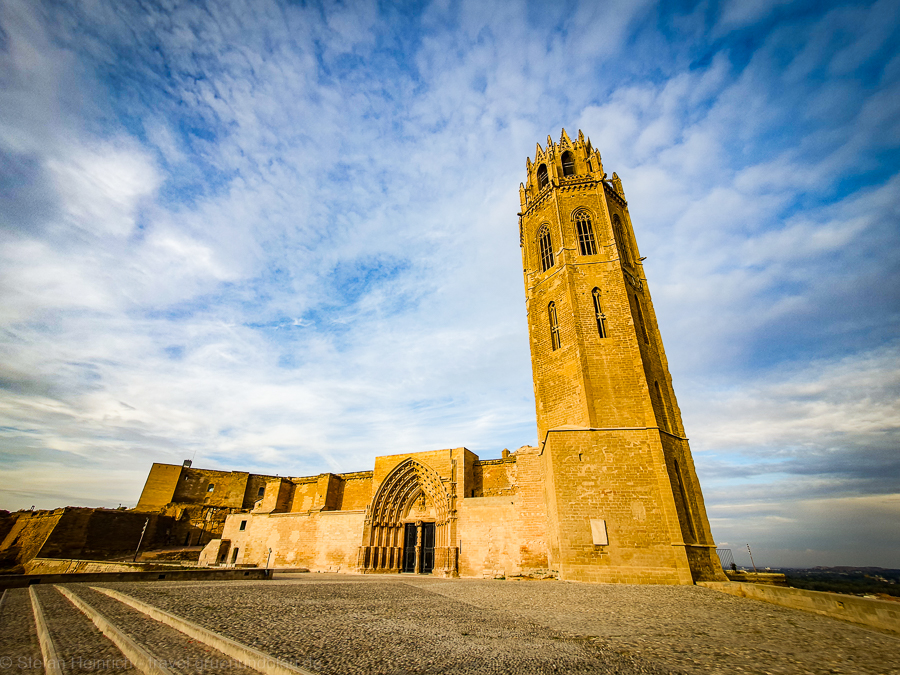
34 Lleida – The Shadow Over the Porta dels Apòstols The hot afternoon sun beat down mercilessly on the alleyways of Lleida, but I had no intention of breaking a sweat on my way up to the mighty Seu Vella cathedral. And why should I? Spain is the promised land for anyone who wants to conquer steep old-town hills without a single drop of perspiration on their brow. A low, metallic hum announced the urban luxury ahead: the city’s outdoor escalators. As the steps glided smoothly beneath me, carrying me meter by meter up the castle hill, I offered a silent prayer of thanks to Lleida’s visionary city architects. There is hardly anything more elegant than floating upward with hands in pockets, gliding past panting pedestrians, and watching the massive sandstone walls of the cathedral gradually emerge from a sea of rooftops. Reaching the top, I strolled over to the Porta dels Apòstols, the imposing main portal. Even from a distance, I could hear a resonant, well-trained voice. A tour guide, cloaked in the absolute authority of his office, stood with an index finger raised before a cluster of tourists who hung spellbound on his every word. I inconspicuously adjusted my pace, crossed my arms, and casually slipped into the outer edge of the group like a paying guest. The guide paused before a particularly ornate niche and dramatically lowered his voice: “Look upon these stones, senyores y senyores! The year is in the 14th century. The great master stonemason Bartomeu has been commissioned to create this portal. Years of his life were poured into the figures of the Apostles, but when it came to his masterpiece—the recess in the arch and the statue of the Virgin Mary—his luck ran out. His hands grew heavy, his mind weary. The figure remained stiff, cold, unfinished. Eventually, his young apprentice secretly took up the tools. In just a single night, driven by divine inspiration, the youth carved the face of the Madonna. When Bartomeu stepped onto the scaffolding the next morning, he couldn’t believe his eyes. It was a figure of such incomprehensible, flawless beauty that the stone itself seemed to breathe. But instead of awe, dark bile welled up inside Master Bartomeu. Envy consumed his heart. He could not bear the thought of being outshone by his own student. In a blind rage, he grabbed his heaviest mallet and struck the youth full in the face. The apprentice reeled, lost his footing, and plunged from the highest scaffolding to his death on these very cobblestones before the eyes of the horrified onlookers.” The guide took a well-calculated dramatic pause. But while the group murmured in awe, he slowly turned around. His gaze locked onto me. Throughout his entire monologue, he had been casting subtle, disapproving glances in my direction. It certainly hadn’t escaped his notice that I had joined his paying audience without contributing a single cent for a ticket. Now he saw his chance to humiliate the free-rider in front of everyone. He offered me a condescending, smirk-laden smile, pointed his index finger at me, and spoke loudly enough for even the last person in line to hear: “Well now… I must say, in my career I have certainly had better listeners than this gentleman here in the blue cap!” A few heads turned toward me with amused grins. The group waited for my embarrassment. But I didn’t so much as blink. I stepped half a pace forward, calmly tipped the brim of my cap, and replied in a steady, carrying voice: “Well, my dear sir—and I have certainly heard better legends than this exact one. In fact, I already know it. Exactly three months ago, I heard it at a church in Vilnius, the capital of Lithuania. There, too, it just so happened to be the very last stone on the facade that the apprentice carved far better than his master. And there, too, the master pushed the poor boy off the scaffolding out of pure envy.” I paused briefly to let the sentence hang in the air, then added with a smile: “Looks like stonemasons across medieval Europe had the exact same little PR problem.” A loud snort broke the ice. First an older gentleman in the front row burst out laughing, and then half the group joined in with hearty laughter. The guide turned bright red in an instant. His condescending smile froze on his face. He cleared his throat hurriedly, glanced at his watch, and clapped his hands together: “Well then! Moving along to the cloisters, we have very little time!” With brisk steps, he herded his group away. I remained alone at the Porta dels Apòstols, leaning comfortably against the cool sandstone wall and enjoying the view over the city—secure in the knowledge that even without a ticket, you sometimes get the best entertainment.