


Bardenas Reales and the Song of the Semi-Desert Wind: The Legacy of Sanchicorrota
Traveling in an old yellow postal van comes with its own set of rules. It’s a slow, honest way to drive. But the moment you cross the border into the Bardenas Reales—that bizarre, surreal desert of clay and sandstone in southern Navarre—the road abruptly transforms into a track of deep potholes, loose gravel, and fine, yellowish dust.
I sat behind the wheel of my van-colossus, both hands gripping the steering wheel tightly as the vehicle crept step by step across the dried-up moonscape. Walking pace. The jagged terrain allowed for nothing more, unless you were willing to sacrifice your suspension on the altar of the semi-desert.
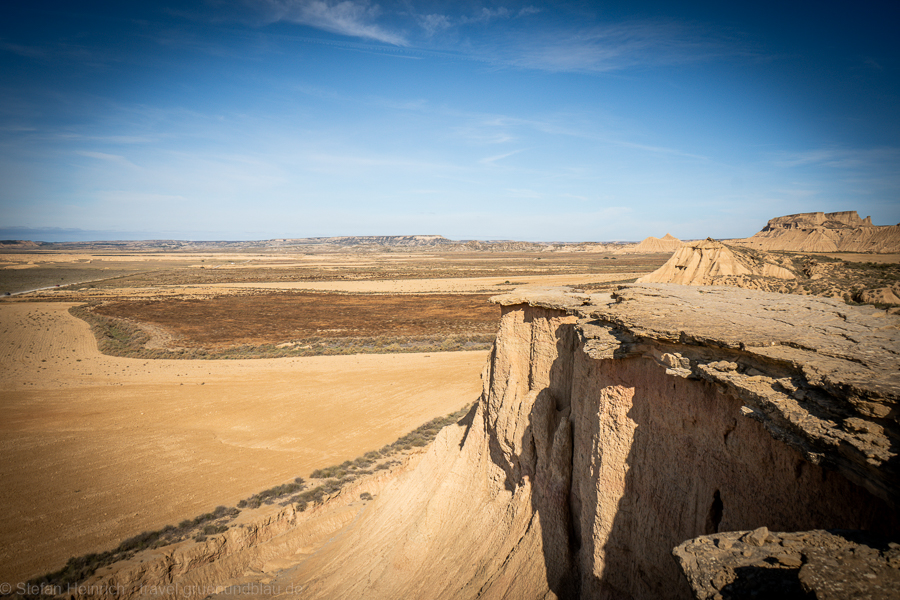
There was not another soul in sight. No fellow vanlifers, no day tourists, not even a stray dog. Just the endless wasteland of deeply eroded canyons, dry riverbeds, and the sharp silhouettes of the cabozos—those mesa mountains jutting out of the earth like gigantic sculptures.
And then there was the wind.

It didn’t just blow; it ruled. The Cierzo, that notorious, ice-cold katabatic wind from the Ebro Valley, swept over my postal van, rattling its doors. It lifted thin veils of ocher dust from the earth and made the vehicle sway with a steady, menacing regularity. The deeper I ventured into the heart of the Bardenas, the louder the whistling became against the window seals.
Eventually, I reached the icon of this no-man’s-land: Castildetierra.
Rising sharply into the steel-blue sky like a massive pyramid sculpted by wind and weather, the clay pinnacle stood as a monument to transience, carved by millennia of erosion. I turned off the engine. The sudden silence inside the van lasted only a heartbeat before the wind began drumming against the bodywork.
I took a deep breath, opened the driver’s door, and stepped out into the desert.
The wind hit me like a physical force. It tugged at my jacket, roared in my ears, and whipped up sand that stung softly against my skin. Yet as I walked closer to the base of Castildetierra and let my eyes trace up the steep flank of the rock needle, the uproar shifted.
The untamed howling of the Cierzo, caught in the fissures and caves of the jagged earth, acquired a melody. It became a rough, throaty, whispering frequency that seemed to rise not from the air, but directly out of the stone. When you drive alone in the silence for hours, your mind can play tricks on you. But in that moment, I was certain: the wind of the Bardenas was speaking to me.
It whistled through the hollowed rock faces, and within its multi-layered hiss, words began to form. An ancient voice, weathered by sand, began to weave its tale:
“Do you hear me, stranger on your four wheels? You drive slowly, yet you are not the first to seek refuge here from the eyes of the world. Five hundred years ago, this land belonged to no king, no bishop, and no army. It belonged to me. Sancho Rota was my name. But history calls me Sanchicorrota—the King of the Bardenas!”
The wind blew sharper, spinning a spiral of dust directly at my feet, and the voice within the howl grew stronger, almost defiant:

“Look at it, the mighty rock of Castildetierra! In its shadow and in the deep caves beneath your feet, my heart once beat. I was no ordinary thief. The rich, the proud merchants of Zaragoza and Tudela, trembled whenever they had to cross the desert. With my thirty loyal men, we lay in wait for them in the ravines. Gold, silk, grain—we took it from the sated. But we did not keep it for ourselves. We brought it to the starving shepherds and impoverished peasants of the Bardenas. To the Crown, I was a demon; to the people, a savior!”
I zipped my jacket up to my chin. The wind blew so hard that tears welled in my eyes, but I couldn’t tear my gaze away from Castildetierra. It was as if the shadow of the bandit king were taking shape right against the rock face.
“Do you know how to survive in a desert where two hundred knights are hunting you?” the Cierzo hissed softly and mischievously, as if whispering a secret into my ear. “Through cunning! Whenever the soldiers of King Juan II searched for my tracks in the dust, they found them. But the tracks never led to me—they led away from me! I had the horseshoes of my men’s horses nailed on backward! The fools followed the prints for miles in the wrong direction, while we sat behind their backs in the shadow of Castildetierra, laughing and drinking their wine.”

A sudden gust of wind ripped at the hem of my hood, loud and cracking like a gunshot.
“Yet no king tolerates a second ruler in his realm,” the voice boomed darker now, carried by a low, rumbling howl that vibrated through the canyons. “In March of 1452, they had had enough. The king sent an army. Over two hundred knights surrounded the Bardenas. They occupied every spring, every pass, every cave. There was no escape. They drove me here, to the foot of this rock.”
For a brief, suffocating moment, the wind seemed to stand completely still. Not a grain of dust moved. The silence was as heavy as lead.
“They wanted to take me to the gallows. They wanted to see my head on a pike to humiliate the people. But Sancho Rota bows his knee to no king! As the knights’ armor gleamed in the sun and the circle tightened, I drew my own dagger. One strike to my own heart—fast, cold, and free. I gave my life to the desert, but never my freedom!”
A tremendous gust crashed through the clay ravines like a strike on a kettledrum. Dust swirled high, shrouding Castildetierra in an impenetrable yellow veil, turning the roar of the Cierzo into a triumphant chorus.

“They dragged my lifeless body to Tudela, they put me on public display to prove that Sanchicorrota was dead! But they understood nothing! My body may have rotted away, but my soul belongs to the Bardenas. As long as this wind whistles through the canyons, I am here!”
The veil of dust slowly settled. The howling of the wind ebbed, returning to that familiar, monotonous whistling drifting across the parched earth. The magical voice had faded away.
I stood there, my face covered in sand, my hair disheveled, staring up at the pointed formation of Castildetierra. The rock stood as it always had—silent, majestic, and mysterious.
I took a deep breath, walked slowly back to my yellow postal van, and climbed inside. As I slammed the heavy door shut, the roaring of the desert outside was noticeably hushed. I turned on the engine. The familiar hum of the diesel filled the cabin.
I cast one last glance in the rearview mirror at the solitude of the Bardenas Reales. The wind kicked up another small plume of dust across the track. I smiled softly, shifted into first gear, and rolled slowly onward through the realm of the bandit king.
