




The Conclave of the Wordsmiths: A Midday Rest at Dante’s Tomb

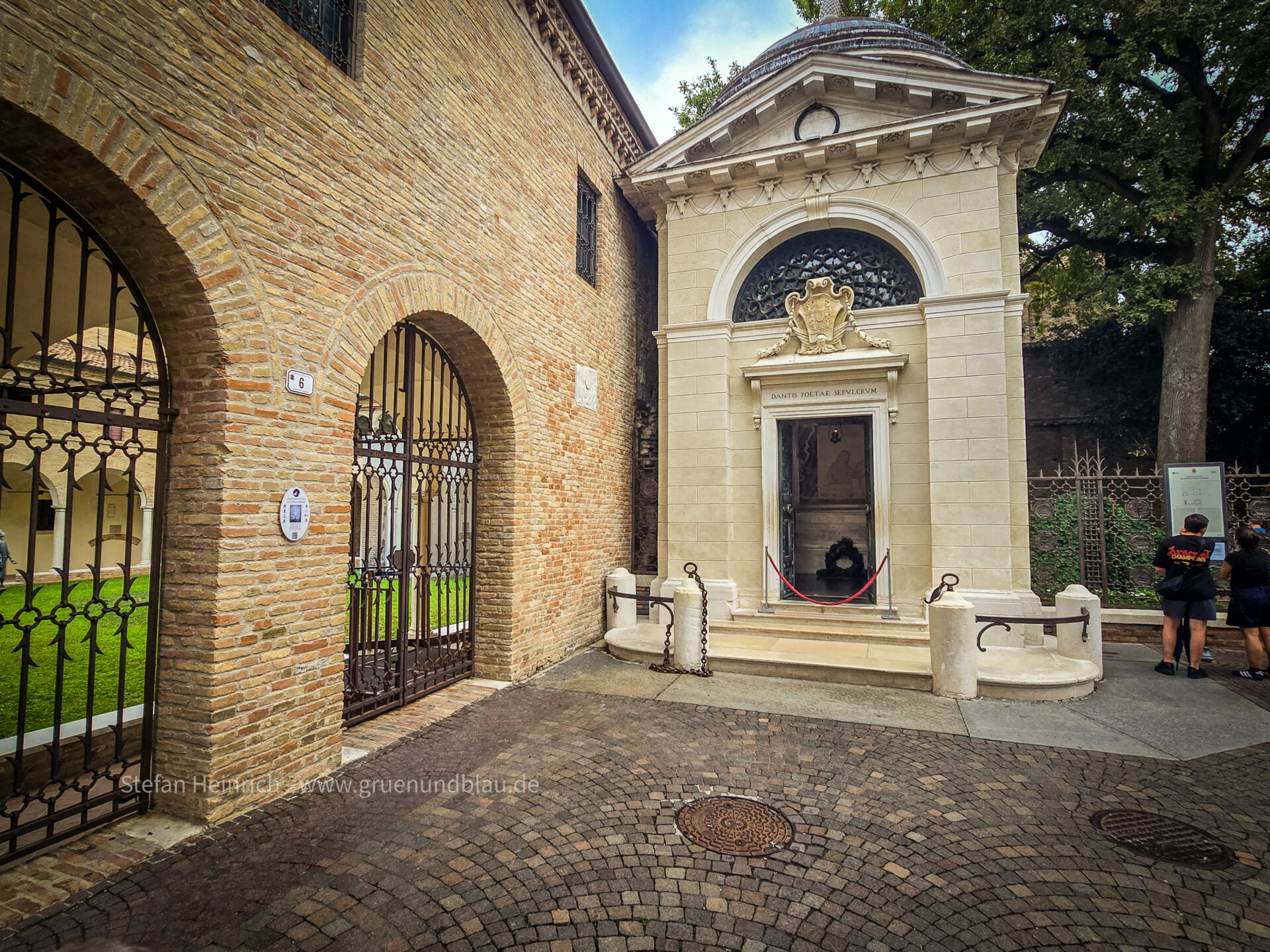
32 The Conclave of the Wordsmiths: A Midday Rest at Dante’s Tomb Traveling makes you tired. Especially after wandering through the cobblestone labyrinth of Ravenna for hours, marveling at mosaic after mosaic, as the cool Adriatic breeze gradually gives way to a oppressive afternoon sun. After my detour to the Tomba di Dante—the simple, white mausoleum where Italy’s greatest poet prince found his seemingly infinite rest—I needed a break. I snapped a few more photos of the burning oil lamp, whose fuel is donated to this day by the city of Florence as a symbolic act of penance, and slipped around the back of the building. On the backside of the tomb, I found a shady spot on an old brick wall warmed by the sun. I rested my head against the cool masonry, let my camera slide onto my lap, and closed my eyes for a brief moment. The quiet murmur of passersby, the peaceful cooing of pigeons, and the warm air instantly lulled me into a state between waking and dreaming. Suddenly, the atmosphere shifted. The sounds of the modern city—the clatter of plastic soles, the whir of e-scooters—seemed to evaporate behind a thick, invisible wall. Instead, a rhythmic, solemn rustle of heavy fabric met my ears, accompanied by deep, measured voices. I didn’t open my eyes completely. Through my eyelashes, blurred by the glare of the blazing sun, I perceived four figures standing directly beside me in the shadow of the monastery wall. They were entirely out of time. Not tourists in functional outdoor gear, but men in flowing, heavy robes, lace collars, and dark cloaks swaying gently in the light breeze. “Unbelievable,” rumbled a rough, deep voice in German that sounded like the Thuringian Forest, ink, and old parchment. “Another whole year has passed since we last gathered at this place.” “Time in the afterlife flows like the Arno in late summer, my dear Martin,” replied a melodious, unmistakably Italian voice full of pride and melancholy. “Yet as long as my flesh rests in this earth and my spirit hovers above the songs of humanity, this place remains our sanctuary.” I held my breath. I couldn’t believe my eyes and ears, yet I didn’t dare move for fear of driving the vision away. “Ah, Signor Alighieri,” a third voice chimed in, its sentence structure steeped in fine Spanish irony and the soft cadence of Castile. “You Italians always lean toward the dramatic. But you are right. We are not here to mourn over the ashes of the past, but to celebrate the Word. Look at these people walking by over there. They speak, they curse, they write poetry—and they have no idea who handed them the tools to do so.” The fourth man, draped in a fine English ruff collar, stepped forward. His gaze was wild, filled with poetry and razor-sharp powers of observation. “They use our phrases without knowing our names, my dear Miguel,” he murmured in Elizabethan English that nonetheless seemed understandable to everyone. “To be or not to be—they carry our thoughts on their tongues as if they were their own. We did not merely give them words; we created their world.” There it stood—the most incomprehensible gathering in world literature. Dante Alighieri, the father of the written Italian language, who tore Tuscan from the shackles of the Latin monopoly and shaped the soul of an entire nation with his Divine Comedy. Martin Luther, who listened to the common folk, translated the Bible, and bestowed upon the German language its very first shared grammar and visual imagery. Miguel de Cervantes, who created the modern Spanish language with his knight of the woeful countenance, Don Quixote, and changed humanity’s sense of humor forever. And William Shakespeare, who wove thousands of new terms into the English language and fathomed the human psyche deeper than anyone before or since. “Consider what we have done,” Luther spoke, clenching a powerful fist. “We found dialects—a chaos of fragments! People could barely understand one another from one village to the next. We reached into the mud of everyday speech and molded it into iron and gold. I chose the language of the simple man to let God Himself speak.” “And I chose the language of Hell, Purgatory, and Paradise,” Dante countered, his sharp profile glowing in the sunlight. “I showed them that the vernacular—the Volgare—is capable of bearing the highest peaks of philosophy and the deepest abysses of the human soul. Florence banished me, yet my language united all of Italy!” Cervantes chuckled softly, a dry, wise laugh. “We gifted them their reason, Dante. I gave Spaniards madness and sanity in a single breath. Don Quixote and Sancho Panza—through their dialogues, an entire nation learned how to doubt, hope, and love. We didn’t just invent words. We forged the identity of millions of souls.” “We are the architecture of their thought,” Shakespeare added, looking up at the clear blue sky over Ravenna. “Every time a lover swears an oath, every time a tyrant hesitates, every time a human asks for forgiveness—they walk the paths we cleared through the thicket of the human mind. Our bodies are dust, but our language is immortal.” The four giants stepped closer together. They laid their hands on one another’s shoulders—a silent, centuries-old alliance of wordsmiths who had laid the foundation of the modern world. Their figures began to glow in the harsh afternoon light, while the names Dante, Luther, Cervantes, Shakespeare echoed like a sublime chant between the ancient bricks of the monastery wall. The light grew brighter and brighter, the contours of their mythical cloaks beginning to shimmer and blur— “WOOF! WOOF!” A shrill, feisty bark ripped me violently out of my half-sleep. I jolted awake, sat bolt upright, and rubbed my eyes frantically. Directly in front of my wall stood a small, brown mixed-breed dog on a leash, barking at me excitedly. His owner—an elderly lady carrying a shopping bag—smiled at me apologetically. “Scusi, signore! He didn’t mean to startle
The Secret in the Stone: Why Ravenna’s Sarcophagi Are Better Left Unbroken

32 The Secret in the Stone: Why Ravenna’s Sarcophagi Are Better Left Unbroken Traveling in a van sharpens your eye for life’s peculiar details. As I strolled through the historic center of Ravenna and turned onto Piazza San Francesco, I could hardly believe my eyes. There they stood: massive, ancient stone sarcophagi made of the finest marble, sitting completely unabashed out in the open, directly in front of the old basilica’s facade. No velvet ropes, no museum guards—just tons of Late Antiquity colossi that time had been gnawing on for over fifteen hundred years. Just as I was about to step closer to inspect the intricate carvings along the edges, the sky opened its floodgates. A classic Northern Italian downpour set in. I grabbed my folding bike, Rocinante, pushed it quickly under the protective arcade on the edge of the square, and shook the rain out of my hair. Under the shady arches, I wasn’t alone. A small group of local men stood in a circle, elbows resting casually against the masonry. In front of them sat an impressive collection of green beer bottles. Knock-off time in the historic heart of town. They were talking loudly with animated hand gestures about soccer and the weather. I took the opportunity, stepped closer with a broad grin, and gestured with my thumb over my shoulder at the drenched giants outside in the rain. “Say, guys,” I called out to them in a mix of Spanish and Italian, “are those out there in the coffins maybe your former colleagues who had a bit too much of your homebrew? Or why are you parking the dead right in the middle of the square?” The men paused. A few seconds of silence followed, and then one of them—an older guy with unruly gray hair and tanned skin—burst into a deep, throaty laugh. “Former colleagues! That’s a good one, amigo!” he shouted, taking a big gulp from his bottle and waving me over. “No, no. In there lies old-school royalty. But if you think the sarcophagi out here are strange, you haven’t heard the story of Empress Galla Placidia yet. That one will teach you a thing or two about fire and stone!” He leaned his back against the wall, held his bottle like a scepter, and began telling the story in a dramatic voice: “You have to know that back in the 5th century, Ravenna was the capital of the entire Western Roman Empire. An Empress named Galla Placidia ruled here—a woman of incredible power, wealth, and beauty. When she died, they built her the most magnificent mausoleum, which you can find right around the corner. Inside stand three gigantic, plain marble sarcophagi. “But folklore has been telling the true story of her sarcophagus for centuries: Galla Placidia wasn’t simply laid flat inside like any ordinary mortal. No! They seated the Empress on a massive, fragrant cedar throne, draped her in the heaviest robes woven with pure gold, placed a crown on her head, and sealed the mighty stone tomb. She was meant to reign like a ruling queen in her dark stone chamber for all eternity. “So that posterity could witness this wonder, the stonemasons carved a tiny peephole into the thick marble. For centuries, people came from far and wide. They would approach the sarcophagus, hold a burning candle close to the little hole, and peer inside. And indeed: in the faint glow of the candlelight, you could see the preserved figure of the Empress sitting mute and sublime upon her throne, while the gold of her garments glittered in the dark. “It went well for over a thousand years. Until the fateful year of 1577. “On a damp, cold afternoon, a curious little local boy sneaked into the mausoleum. He desperately wanted to see the famous dead Empress. But the boy was small, the hole was narrow, and the darkness inside the tomb was deep. To see better, he didn’t just hold his burning candle in front of the hole—he pushed it deep inside the cavity of the sarcophagus. “A fatal mistake. The flame touched the centuries-old, bone-dry silk robes of the Empress. Within seconds, a devastating draft caught. The dry-preserved wood of the throne and the precious fabrics caught fire in a flash. The boy screamed and dropped the candle. The cavity of the marble tomb turned into a glowing furnace. By the time the monks came rushing in, black smoke was already billowing from the little hole. “When the fire finally burned out and the smoke cleared, they looked through the charred hole inside: the throne, the robes, the crown, and the Empress herself were completely consumed. Nothing was left—except a handful of gray ash on the cold floor of the stone sarcophagus.” The man paused, took a final sip from his beer bottle, and looked at me intently. “Ever since, the Empress’s sarcophagus has been completely empty. And the moral of the story? Keep your hands off old stone coffins—especially when you’re carrying fire!” The other men nodded in agreement and laughed. The narrator slapped my shoulder in a friendly, camaraderie-filled way, reached for a fresh, unopened beer from a crate on the floor, and held it out to me. “So, you strangely speaking Spaniard—or whatever you are! Let’s drink to that. Sit down with us, the rain’s gonna last a while!” I looked at the cold beer, looked over at the drenched stone colossi in front of the church—which almost looked like ancient monuments in the heavy rain—and shook my head with a chuckle. “Thank you so much for the invitation and the fantastic story,” I said with a grin as I zipped up my rain jacket. “But looking at your sarcophagi out there in the square… honestly, they seem a bit too densely populated for my taste! And before I end up carved in stone myself, I’d better hop back on my folding bike and keep riding through Italy.” The men hooted with laughter, toasted their
The Oracle at the Vegetable Stand: How the Downpour in Comacchio Taught Me About the Ghost Ship of Spina

25 The Oracle at the Vegetable Stand: How the Downpour in Comacchio Taught Me About the Ghost Ship of Spina Originally, I just wanted to skirt past Comacchio, keep the camper strictly on course, and move on. But then, out of the corner of my eye, a channel flashed by: mirror-still water lined with colorful rows of houses, spanned by an imposing, masonry arched bridge. I yanked the steering wheel around, headed for the nearest parking spot, and swung into the saddle to explore this smaller, quieter Venice of Emilia-Romagna. I had barely rolled a few hundred yards along the bank when the sky opened its floodgates without warning. It didn’t just rain—it poured in buckets. Searching for shelter, I darted beneath the protective canvas awning of a small, colorful vegetable stand right on the canal bank. Standing opposite me was an energetic, middle-aged Italian woman, calmly shifting her crates of tomatoes out of the wet. I wiped the rainwater from my face, looked at her with a wry smile, and grinned: “So, this is the famous Italian weather! Always sunshine, blue skies, and hot days, right? And instead, it’s pouring cats and dogs!” The woman paused, looked at me, and burst into a hearty, deep laugh. “Ah, my dear!” she called out, waving her hand dismissively. “Rain is nothing! The weather here in the lagoons can get much nastier, much darker, and much spookier. When la nebbia—our infamous fog—sweeps over the Po Delta in late autumn, you can’t see the hand in front of your face. Even the most seasoned fisherman gets lost in the labyrinth of canals. But you know what? It’s precisely a fog like that to which we owe our most famous story!” She rested both hands on a crate full of oranges, leaned toward me, and began to tell her tale with twinkling eyes: “Many hundreds of years ago, back in the 4th century, our Saint Cassian passed away. His faithful followers loaded his body onto a simple wooden boat to bring him across the canals to us in Comacchio. But right out on the water, a wall of fog rolled in, so thick and black that even the oldest men of the lagoon had never seen anything like it. The rowers completely lost their bearings. They drifted helplessly in circles while the marsh and mud of the ancient, sunken Etruscan city of Spina seemed to reach out for them. They thought their final hour had struck. Then, suddenly, a miracle happened: out of the white darkness emerged a massive ship. It was not burning, yet it glowed from within with an unearthly, golden light. Not a single sound could be heard—no creaking of planks, no splashing of waves. And on the deck stood not a single sailor! This flaming ghost ship of Spina hovered silently like a guardian angel ahead of the small boat. Its bright light carved a shimmering path through the thickest fog, safely guiding the men bearing the saint’s relics all the way to the shores of Comacchio. No sooner had they tied up their boat than the glowing ship vanished into thin air.” The vegetable lady smiled mischievously and patted the crate in front of her. “So next time you’re stuck in the fog here, don’t look for signs—keep an eye out for the glowing light!” At that exact moment, just as she finished her story, the next little miracle occurred: the downpour stopped abruptly. The clouds parted, and the sun bathed the rain-splattered bricks of the bridge in a warm, golden light. I thanked her politely for the wonderful story, bought a net of juicy oranges as a small token of appreciation, and swung back onto my bike. So the downpour had its good side after all—a dry spot, fresh Vitamin C, and a fantastic new legend for my logbook!