



The Secret of Titanium and Puppy's Doghouse: When a Folding Bike Explains the Guggenheim
There are days when, as a full-time vanlifer, you feel like the undisputed king of the road. My morning in Bilbao was precisely one of those moments. I rolled into the city in my camper shortly after nine o’clock and rubbed my eyes in disbelief. Where was the infamous Spanish rush? Where was the usual bumper-to-bumper traffic, the honking chaos, the Southern hustle and bustle of rush hour? None of it. The streets were practically deserted, with only a few scattered souls strolling through the alleyways.
“Wonderful!” I thought. “Bilbao belongs entirely to me today.”
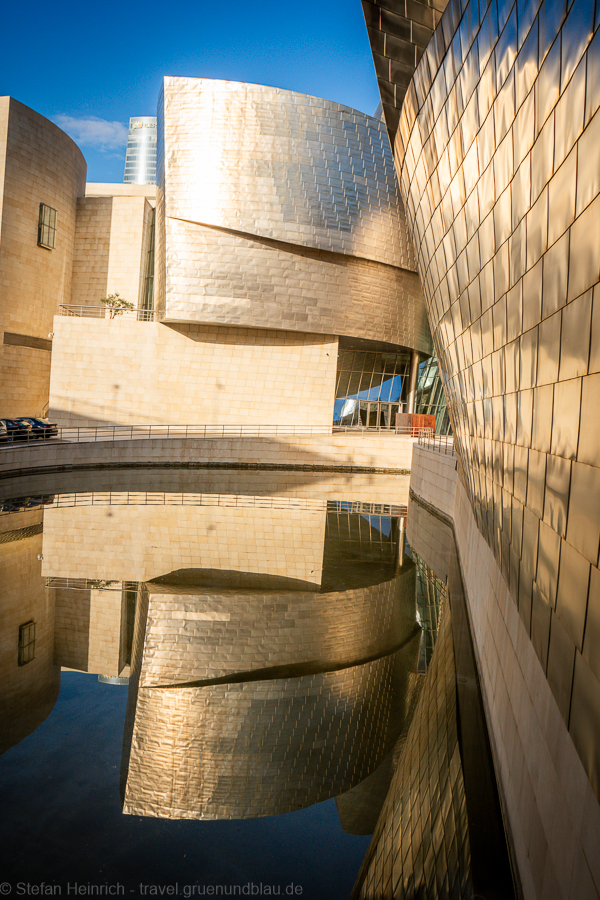
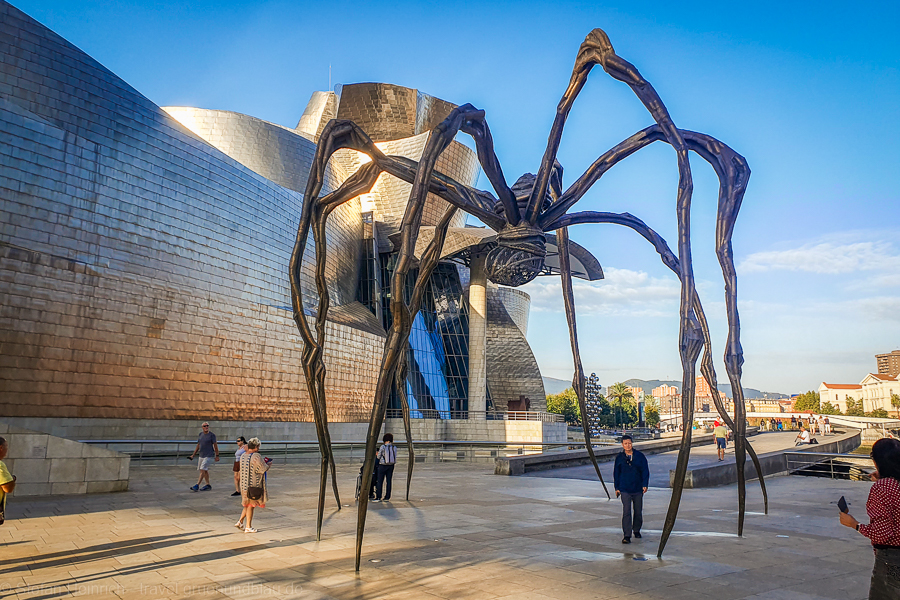
My destination was, of course, the Guggenheim Museum—the city’s architectural sanctuary. I parked the camper, grabbed my trusty folding bike, Rocinante, and pedaled off. For a photographer like me, this building isn’t just a structure; it’s a visual feast. Those sweeping titanium panels! Those organic shapes gleaming in the morning light like the scales of a gigantic, sleeping silver dragon!
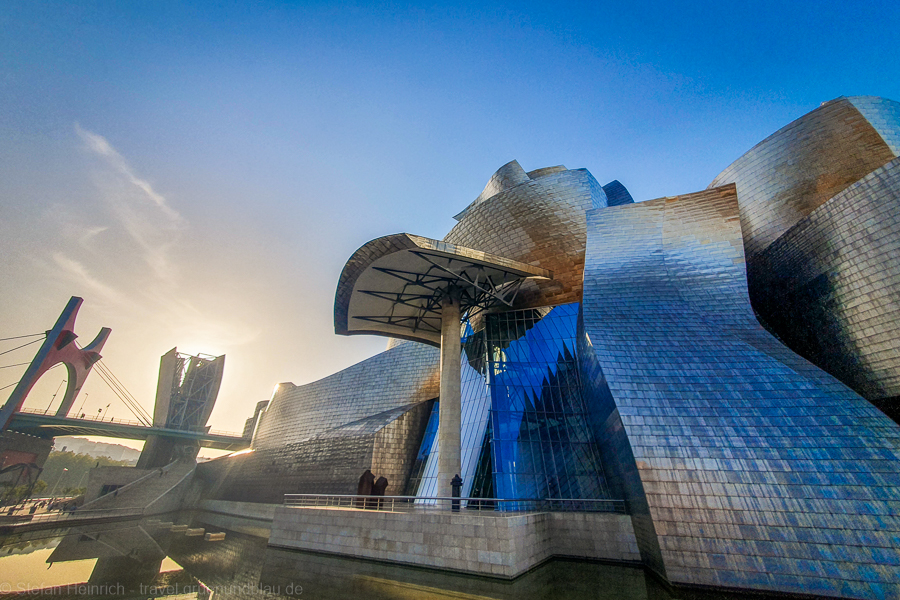
I pulled out my camera and snapped photos from every conceivable angle: from below, from above, from a worm’s-eye perspective, with the river flowing in the background. Hours flew by. Very gradually, a few more people trickled onto the plaza, but for a world-famous monument, it remained surprisingly uncrowded by 11:00 AM.
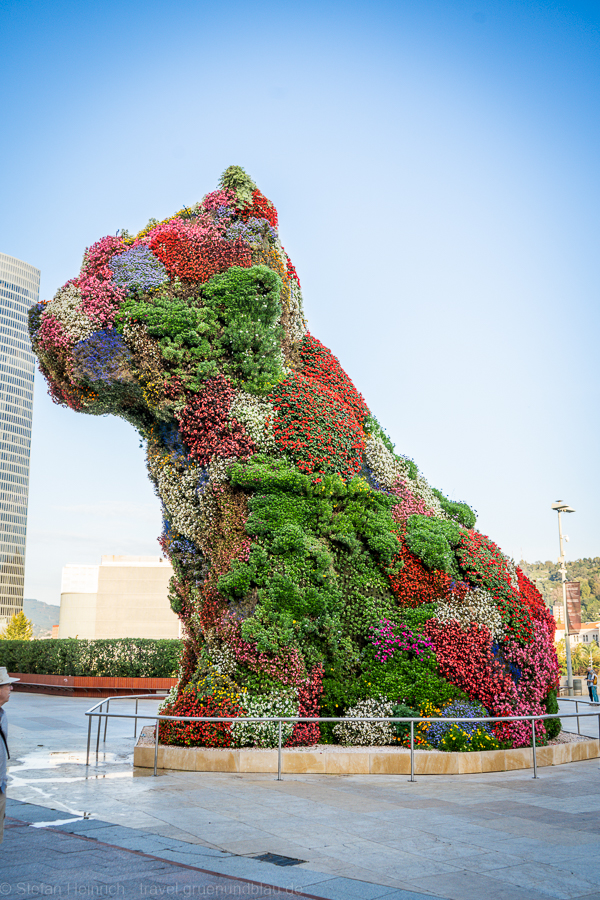
To easily explore the grand outdoor staircases, I decided to briefly park my ride. Rising above the plaza in front of the museum was “Puppy”—a twelve-meter-tall giant puppy covered top to bottom in colorful flowers, created by Jeff Koons. A truly charming little fellow. I chained Rocinante to a post right next to the giant floral dog and immersed myself for another hour in the world of titanium reflections.
When I finally returned and reached for the lock, my folding bike cleared its throat. Yes, Rocinante talks sometimes. You spend a lot of time together as a full-time vanlifer.
“You are going to take a picture of Puppy too, aren’t you?” Rocinante asked in a tone that sounded suspiciously like subtle lecturing.
I paused while unlocking and blinked. Normally, my bike stays strictly out of my photographic decisions. As long as I oil the chain and don’t slam it over curbs, it’s perfectly content.
“Uh… sure,” I replied obediently, grabbed my camera, and dutifully took a few snapshots of the giant floral pup. Then I swung into the saddle, and we set off again.
Hardly had the small wheels started rolling over the pavement when Rocinante chimed in: “Do you actually know what you’ve been photographing for hours?”
“Well, obviously,” I said proudly, trotting out my amateur art history knowledge. “The Guggenheim Museum Bilbao! Designed by star architect Frank Gehry, completed in 1997. A masterpiece of deconstructivism consisting of 33,000 razor-thin titanium plates that saved the city from economic decline. A world-famous landmark!”
Rocinante sighed audibly through the handlebars. “Oh, you naive shutterbug. What do you mean ‘grand landmark’? What do you mean ‘museum’? It’s a hut. A nice hut, mind you, but just a hut nonetheless.”
I hit the brakes so abruptly that the coaster brake gave a soft squeal. “What do you mean, a hut?! It’s a modern icon!”
“You parked me right next to Puppy for an hour,” my folding bike replied with complete conviction. “And we talked. He told me the whole truth. Back then, the people in city hall were trying to figure out how to properly house the greatest, most colorful, and best-behaved dog in the world. And since Puppy is a world-class dog, they built him a shelter out of the finest metal to keep a bit of rain off him. All the tourists actually come here just to see him! But because they’re embarrassed to admit they sat on a plane for hours just to pet a twelve-meter-tall flower puppy, they dutifully go into his doghouse afterward and pretend to care about modern art.”
I stared down at my folding bike. “A 100-million-dollar titanium doghouse?”
“From Puppy’s perspective, entirely appropriate,” Rocinante purred. “He even let slip that the roof is curved like that so the rain drains better when he sleeps under it. And the titanium? Reflects the sun so his flowers don’t wilt. Logical, isn’t it?”
I couldn’t help but laugh. The idea that Frank Gehry’s true assignment was simply to design the most luxurious doghouse in human history had an undeniable poetry to it.
It wasn’t until late afternoon, back at the camper after stowing Rocinante in the rear and sitting down at the dining table with a cup of coffee, that my eyes caught my travel calendar on the wall. I stared at the red date.
October 12th.
It hit me like a flash.
It hadn’t been my brilliant timing strategy that made the streets so wonderfully empty in the morning. Nor was it because all the Spaniards were packed inside the Guggenheim. It was the Fiesta Nacional de España—the Spanish National Day! Half the nation was still comfortably tucked in bed or celebrating with family while I had been strolling through a deserted city.
I leant back, chuckled, and looked back toward the folding bike. Sometimes a national holiday lets you enjoy a city all to yourself—but the truly great secrets of architecture are still best learned from a colorful flower dog and a precocious folding bike.