



The Lizard Oracle of Paestum: Philosophy Among Ancient Pillars
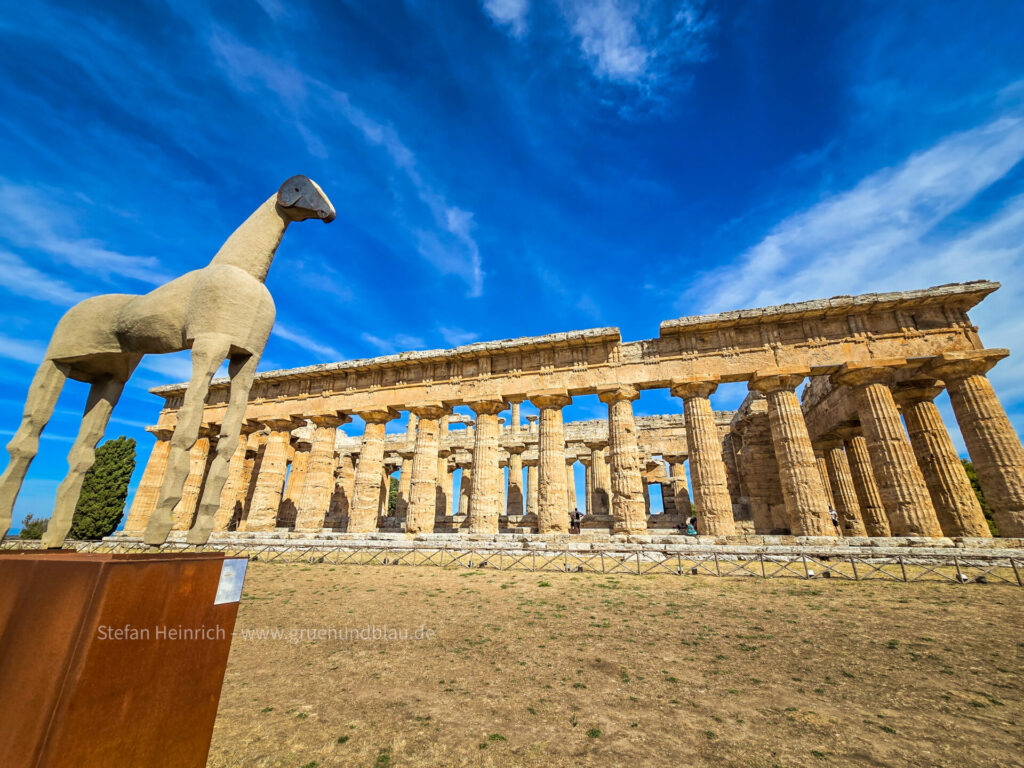
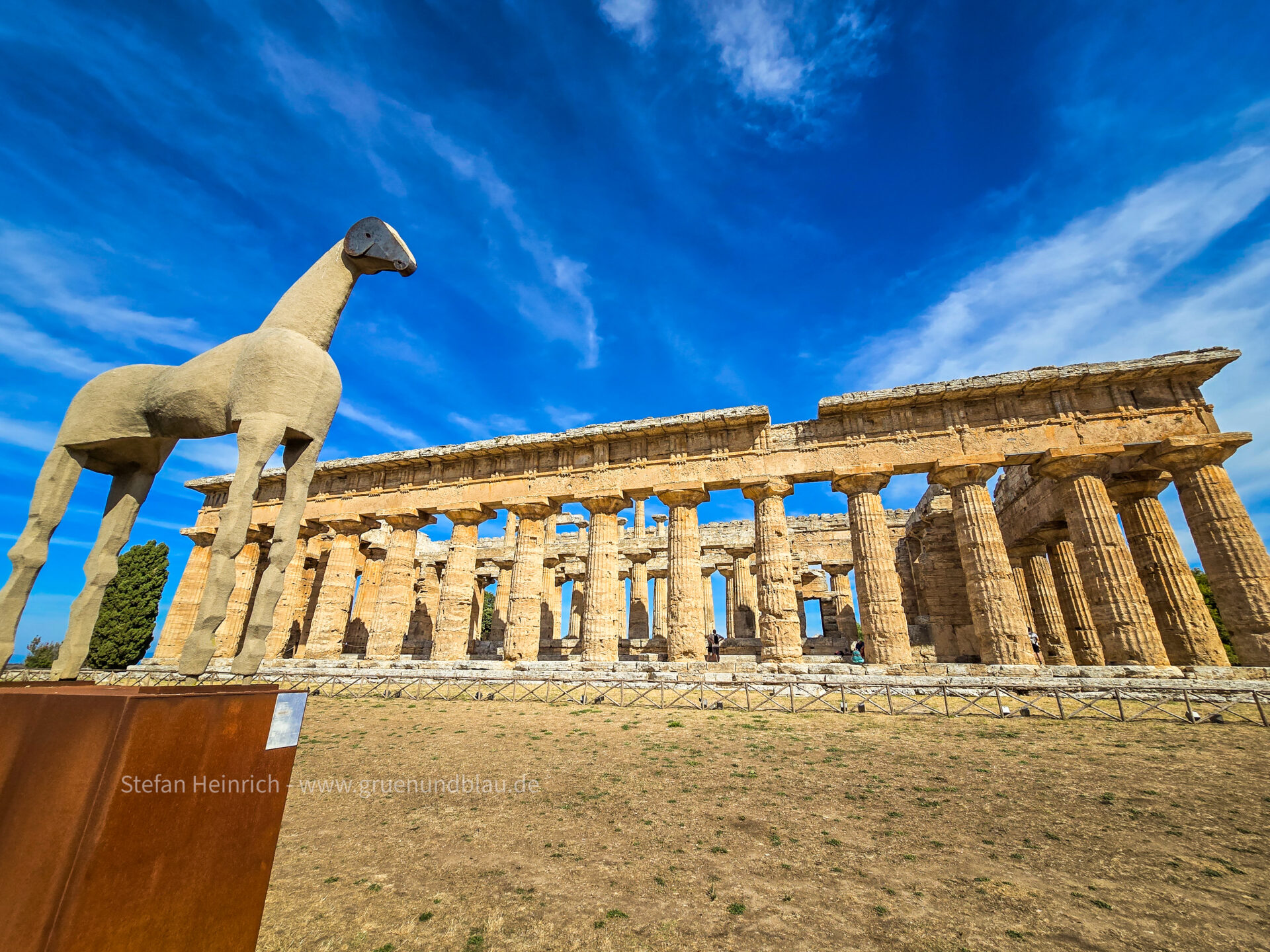
The Lizard Oracle of Paestum: Philosophy Among Ancient Pillars Truth be told, I initially planned to bypass the ancient site of Paestum in the Campanian province of Salerno and zoom straight ahead to Agropoli. But the road, quite literally, leads right past history. As the mighty Greek temples loomed before me in the glaring sunlight under a brilliant blue sky, my spontaneous thirst for adventure won out. I pulled my van into the parking lot and dutifully joined the crowd of tourists. The complex is huge—alongside three gigantic temples, an entire ancient city stretches out here. Luckily, the streams of visitors quickly dispersed. And so the impossible happened: I found myself strolling completely alone through the shadowy halls of one of these massive structures. Enveloped by the awe-inspiring backdrop, I jokingly thought I might test whether the ancient gods still had reception. I broadcasted my inner voice: “God who lives here! Can you hear me? Tell me something about this place!” The reply wasn’t long in coming—though hardly in the way I expected. “Who’s squawking so rudely around here?! Scaring off all my fat flies! Quiet, please!” croaked an annoyed voice in my mind’s ear. I paused. Normally, the only thing responding to my inner monologues is a growling stomach. I scanned the pillars and looked up at the sky: “Who are you?” “Down here, wise guy! Where are you looking? You searching for the moon?!” I looked down at the stone floor. Clinging directly to a column was a remarkably handsome lizard. Its scaly coat shimmered with green and white speckles, accented by astonishing deep-blue spots along its sides. “Well, aren’t you a pretty one,” I replied charmingly. The lizard remained unimpressed: “What do you want here, and why are you shouting so loud?” “I just wanted to tour the temple and learn a bit about the builders and their god.” The reptile practically rolled its eyes. “Just look around! The people here simply worked hard, ran a decent economy, and built a city. And, as always when something thrives, the priests came around the corner. They told them fairy tales about a god and how to worship him—and that they had better pay up for the temple and the priests.” “And where did they all go?” I asked, intrigued. “The climate shifted. Suddenly, mosquitoes and diseases arrived. So the people fled to the mountains.” “And the mosquitoes?” “We ate ’em!” the lizard grinned maliciously. “Everything here was forgotten, overgrown by forest. Only much later did people return to dig it all up again. As if they were searching for something they didn’t already know!” “Well, maybe they’re learning something about the past,” I tried to appease it. “Nonsense!” the scaled creature dismissed. “People haven’t changed one bit since then. They do the exact same things, think the exact same way, and behave the exact same way. They dress themselves up differently today, but that’s just a facade. Believe me, zero change!” “You’re quite the genius, aren’t you? What makes you so sure?” The lizard drew itself up: “Look at the past, and you’ll see the future! Nobody knows the people from back then anymore, their gods are dead, their houses are dust, their wars forgotten. Now look around today: you give yourselves important titles, worship new gods, build houses way too big for you, and wage new wars. Look at these ruins—that is precisely what will be left of you!” A stunned silence on my end. The philosophical slap hit home. The lizard broke the silence with a click of its tongue: “Right, no more time for this silly banter. I’m off to catch flies. By the way, that’s the one thing I’ve never understood about you humans: why don’t you eat any of these delicious, fat flies?” It tapped its forehead with its little finger and scurried off in a flash—leaving me behind, deep in thought among the silent witnesses of history. http://gruenundblau.de/wp-content/uploads/2026/09/20260921_123732.mp4
Sneakers, Servers, and Silicone: How Carlo Acutis Went from Teenager to the First Cyber-Saint
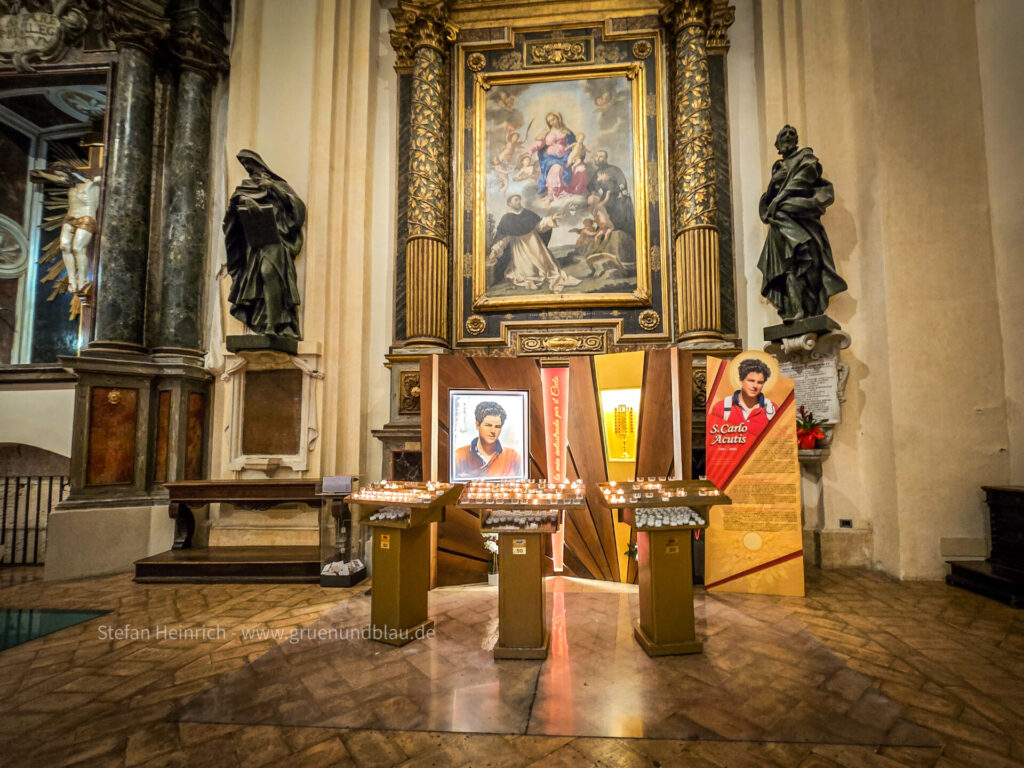
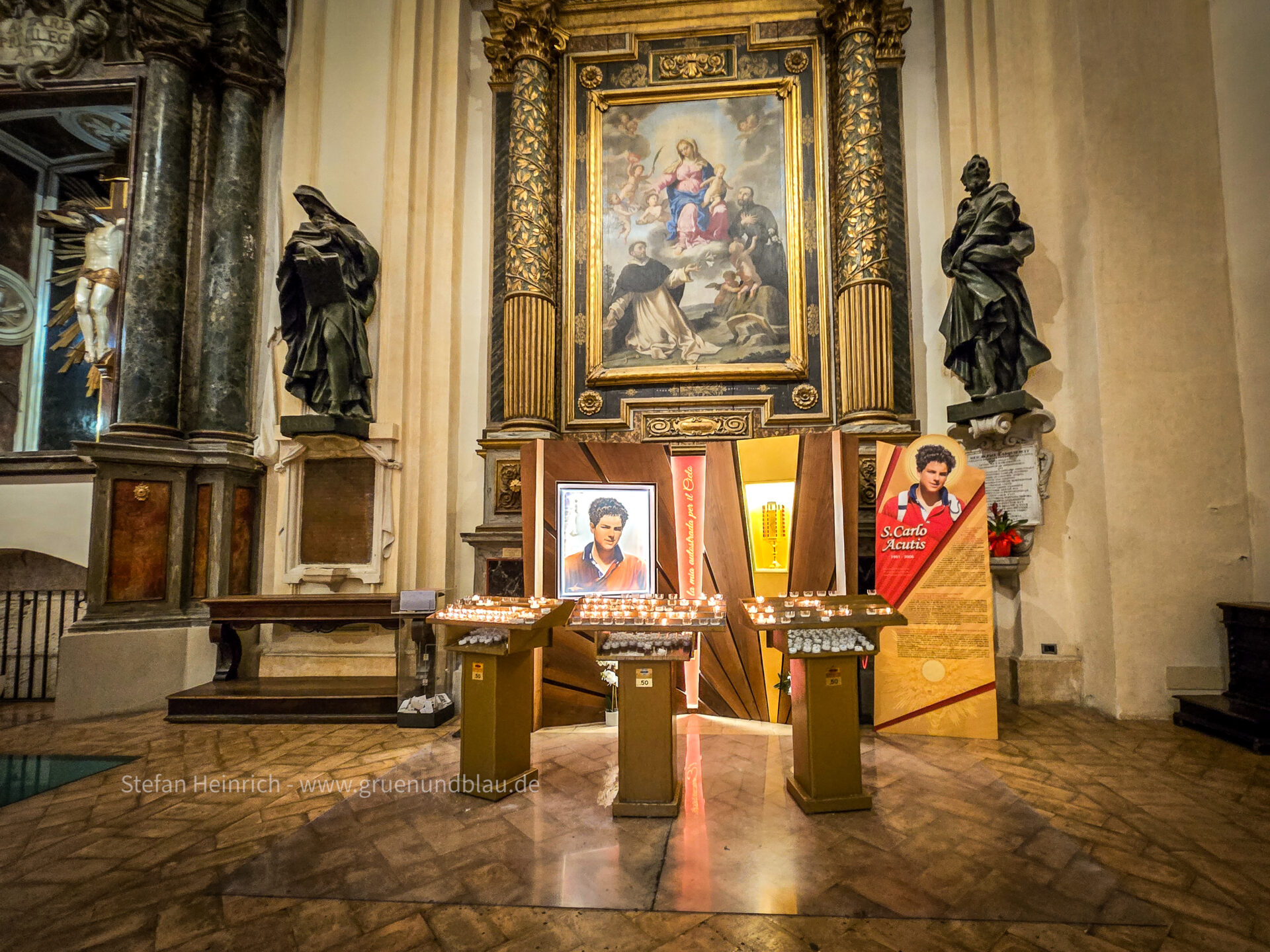
Sneakers, Servers, and Silicone: How Carlo Acutis Went from Teenager to the First Cyber-Saint My recent experiences at the peak of La Verna had sparked my curiosity. If the medieval cult around stigmata and melting rocks worked so well, what did Umbria’s religious epicenter have in store? So I steered my camper south, climbing steeply up toward Assisi. Naturally, I expected the usual traces of Saint Francis. What I discovered there, however, surpassed anything I’ve encountered on four wheels in terms of sheer curiosity and staging: the story of Carlo Acutis. Anyone who reads through official biographies, media reports, and Catholic Church documentation (feel free to check the facts yourselves; I’m relying purely on the results of my own research) comes across a canonization that couldn’t be placed more perfectly in the digital age. Carlo was born in 1991. Just a normal teenager, you might think—yet he was fascinated by computer science and religion. At the tender age of eleven, he created a PDF document meticulously compiling 136 alleged eucharistic miracles—historical cases of host discolorations. (People also say he built a website, though there’s no evidence for that; all websites on the topic were registered after his death.) What began as a digital side project quickly gained massive momentum: the texts were printed out, displayed in Rome, and eventually traveled as a touring exhibition through an estimated 10,000 parishes worldwide. In October 2006, tragedy struck: at just 15 years old, Carlo succumbed to aggressive leukemia within a matter of days. He was buried in his family’s vault in Assisi. What followed was the birth of a modern myth. The media quickly dubbed him “God’s Influencer” or the “Cyber-Apostle.” The Vatican recognized the enormous potential of this narrative for reaching a younger audience. For an earnest teenager to become a saint, Church rules require proven miracles. The first followed in 2010 in Brazil: a boy with a congenital pancreatic disease was allegedly cured after touching a piece of cloth from Carlo’s sweater. Researching the diagnosis reveals that this disease typically runs in flares, with many sufferers experiencing periods completely free of symptoms. For Rome, however, the incident was enough: the phenomenon was recognized as an official miracle, and Carlo was beatified in 2020. The required second miracle wasn’t long in coming: a mother from Costa Rica prayed at the tomb in Assisi for her daughter, who was in a coma following a severe bicycle accident with traumatic brain injury. On that same day, the daughter reportedly began breathing independently again. With that, the path was clear: in September 2025, the teenager with the miracle PDF was officially canonized by Pope Francis. Up to this point, it sounds like a modern success story of faith. But wandering through Assisi, you encounter a side of this veneration that takes some getting used to, to put it mildly. Back in 2019, Carlo’s body was exhumed from the family vault. During this procedure, his heart was removed—a relic henceforth kept in a precious shrine at the Basilica of Saint Francis and toured in display cases through various European cities. The rest of his body was initially displayed publicly in a wooden coffin and ultimately laid out in the church of Santuario della Spogliazione in Assisi. There he lies to this day in an open glass coffin, dressed in everyday clothes: jeans, a sports jacket, and Nike sneakers. Standing before the casket, you look upon a flawless face and peaceful hands. A medical miracle? Not quite. The face and hands were elaborately remodeled and reconstructed from silicone to give the corpse an uncorrupted appearance and present posterity with the image of a sleeping boy. I’ll spare you the photo of the corpse with a silicone face in a glass coffin, complete with a bench for visitors in front of it. Everything neatly set up with orderly access lanes. In the winding alleyways of Assisi, the “Cyber-Apostle” has long become a major economic factor. Alongside traditional Saint Francis statues, souvenir shops sell pins, keychains, prayer cards, and mugs featuring the image of the teenager in a tracksuit. Standing against this historic backdrop, watching the streams of pilgrims before the glass coffin, you can’t help but wonder where the line lies between deep-felt devotion, modern event marketing, and a bizarre relic cult. I’ll leave the commenting to you at this point—form your own opinion.
When Stones Turn Soft and Angels Grow Wings: The Spectacle of La Verna
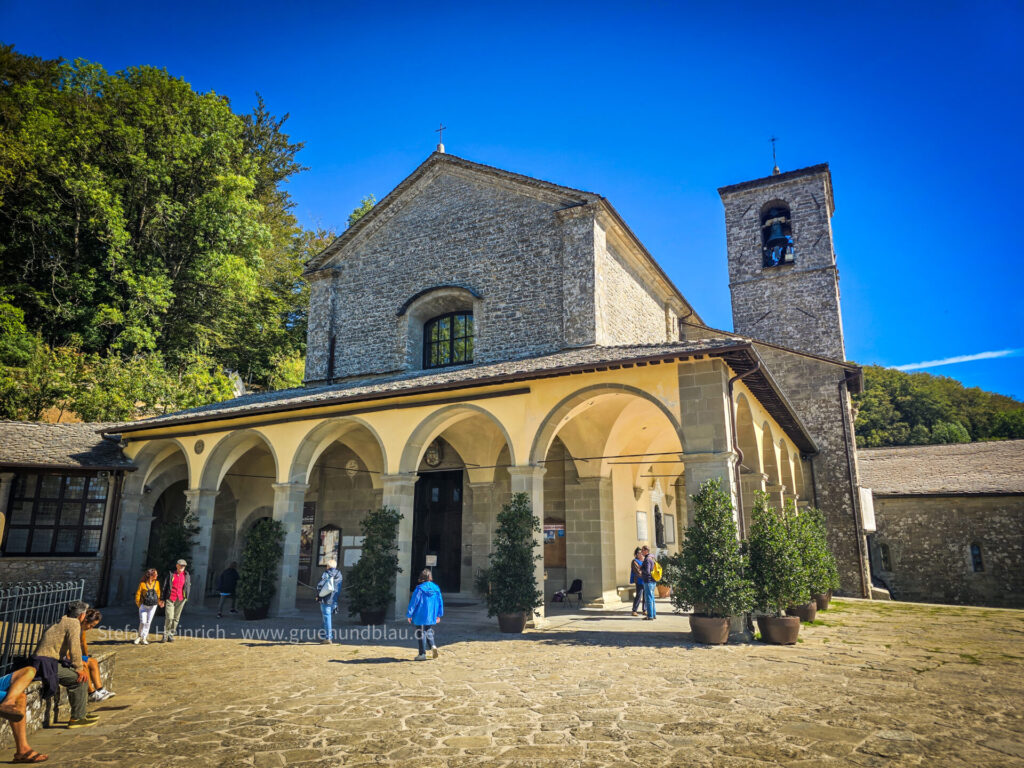
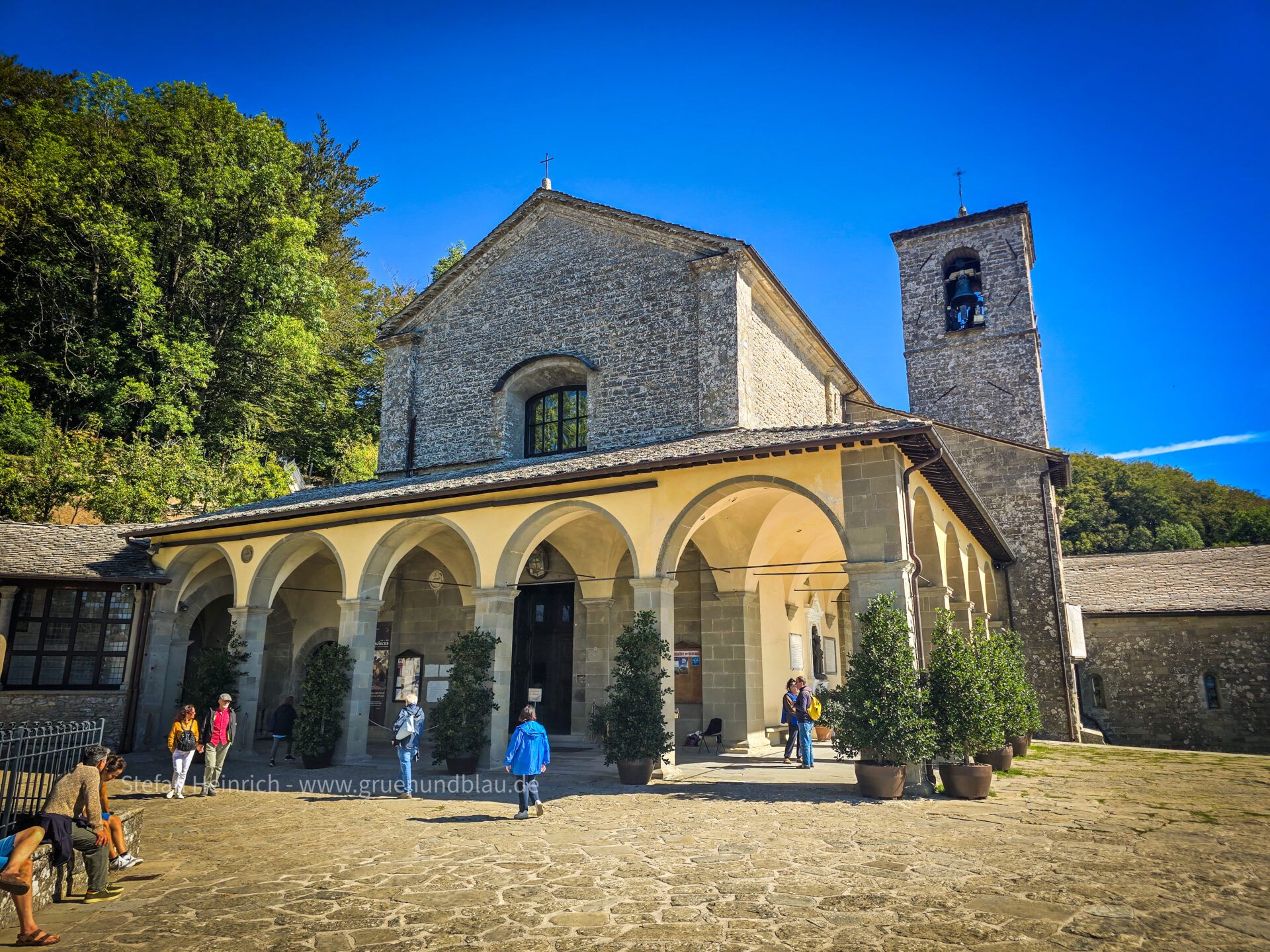
When Stones Turn Soft and Angels Grow Wings: The Spectacle of La Verna All I was really looking for was a quiet mountain hike—a few winding trails, fresh forest air, and some peace and quiet. Yet, as if drawn by some strange magnetism, my van eventually rolled into the parking lot of the Santuario della Verna. It wasn’t until the first busloads of tourists and pilgrims came streaming past me that it dawned on me: this place is no hidden gem. I apparently have an uncanny talent for landing right in the epicenters of global relic worship. High up on the rugged cliffs of the Casentino, you encounter the perfect symbiosis of untouched nature and meticulously crafted legend-making. What tour guides sell to reverent groups from all over the world with deadly serious expressions requires a fair amount of mental gymnastics from the modern mind. You have to break down the scenario: adults, having traveled thousands of miles, are told with a straight face that back in September 1224, Saint Francis was taking a peaceful stroll through these woods when a seraph—a six-winged angel—suddenly appeared in the sky. The result of this mystical encounter? Francis emerged with the stigmata, the exact same wounds as Jesus after the crucifixion. And if you thought that was the limit of the unbelievable, think again. The myth-making toolkit of La Verna has even bigger caliber stories in store. When the Devil himself tried to push Francis off a steep cliff in a fit of frustration, another miracle conveniently occurred: moments before impact, the hard sandstone liquefied like soft wax to catch the saint gently and safely. It’s no secret that tour guides love a bit of dramatic exaggeration—after all, tourism thrives on a good story. But the tale of the six-winged stigmata angel and the melting rocks definitely takes the cake. Standing among the ancient, majestic beech trees and looking down at the impressive rock chasms, you can’t help but ask yourself: where does genuine faith end and the well-oiled marketing machine of the Middle Ages—which still keeps the cash registers ringing today—begin? As absurd as these stories may seem at first glance, the fascination of this place is undeniable. It’s a compelling spectacle of the human longing for the supernatural. But don’t be too quick to crown La Verna’s stigmata as the peak of the absurd. Keep an eye out for my next post! There is actually a whole new level to this. Soon, I’ll tell you about my encounter with a surprisingly young saint, making these ancient myths look like mere warm-up acts.
In the Shadow of the Castle: Dante’s Footsteps in Poppi
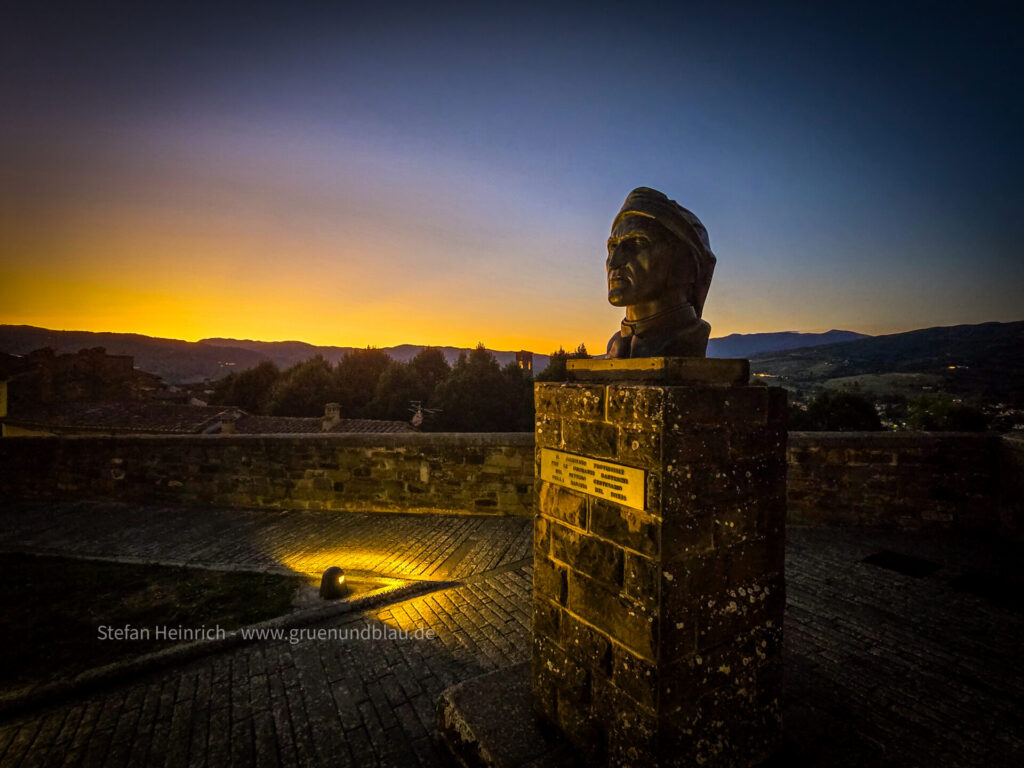
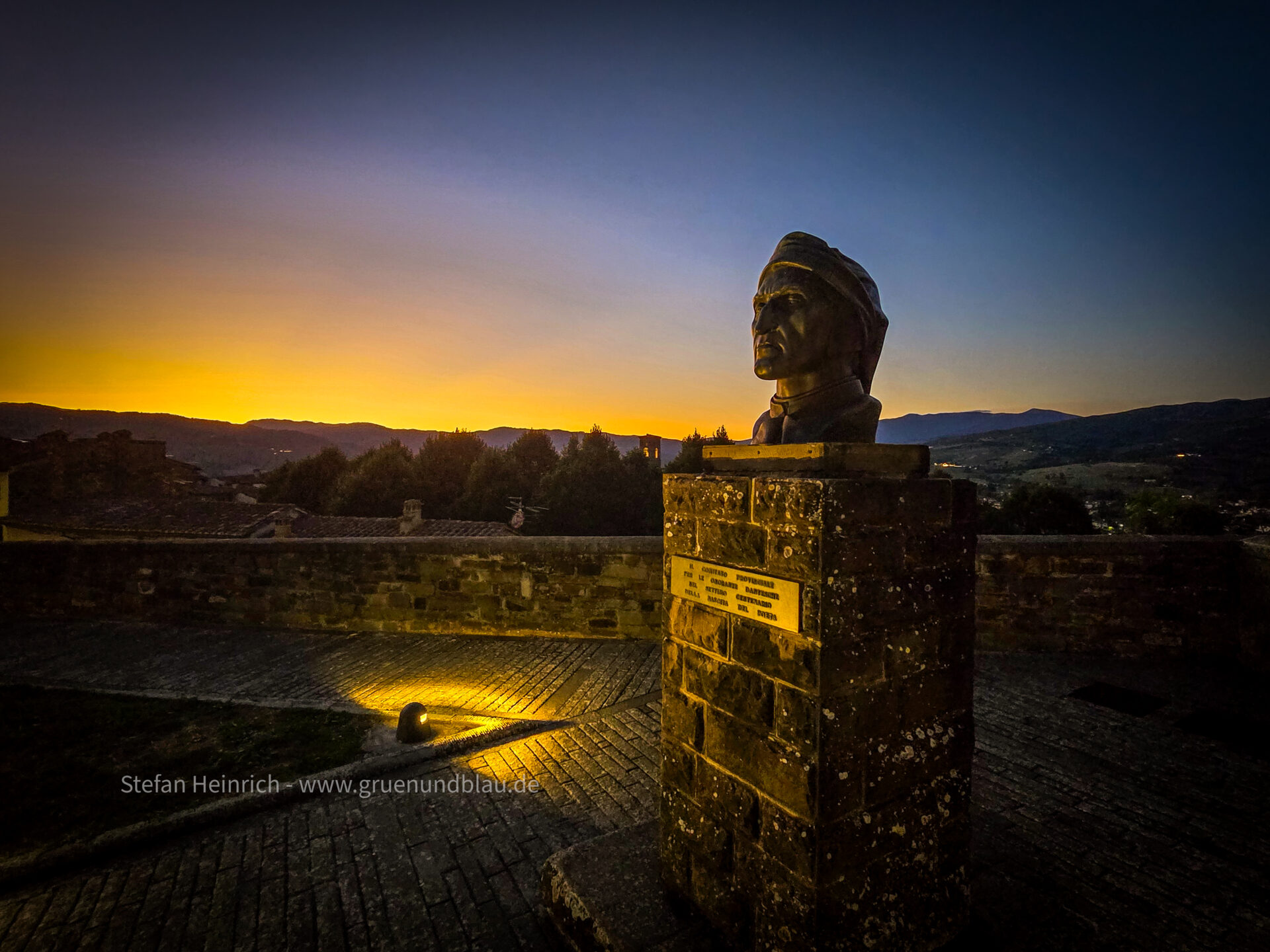
In the Shadow of the Castle: Dante’s Footsteps in Poppi After a wonderful hike through the autumn mountain forests of Tuscany, I drove my campervan down to Poppi. The parking area at the foot of the hill—complete with service facilities—was pleasantly quiet; apart from a few decommissioned RVs, I had the space all to myself. As dusk bathed the valley in soft golden light, I made my way up into the historic old town. Even from afar, the imposing silhouette of a mighty castle rose unyieldingly into the sky, drawing me in like a magnet. Reaching the castle square, I suddenly found myself gazing into the proud, stone face of a bust: Dante Alighieri, Italy’s greatest poet. Dante’s connection to Poppi is etched deeply in both blood and poetry. In June 1289, as a young cavalry soldier from Florence, he fought on the plain of Campaldino, right outside the gates of Poppi. The battle between the Florentine Guelphs and the Ghibellines from Arezzo turned into a ruthless slaughter, with hundreds of warriors losing their lives in the mud. The horrific sight left such a lasting mark on the young poet that he later wove the horrors of that day directly into the dark depths of his Divine Comedy. Years later, Dante returned—this time not as a soldier, but as an exile. Banned from Florence, he found refuge in 1310 at the formidable Castello dei Conti Guidi under Count Guido di Battifolle. Legend has it that the exiled poet locked himself in one of the highest tower rooms, gazing out over the rugged forests of the Casentino, and penned the famous 33rd Canto of the Inferno. Furthermore, within the castle corridors, he learned the tragic tale of Mastro Adamo, a counterfeiter who was burned alive on the nearby hills for forging gold coins. Dante immortalized him as well in the depths of hell. Standing in the shadow of the illuminated castle walls that evening, I could faintly feel the poet’s spirit lingering in the cool night air.
Monks, Mosquitoes, and the Heavenly Ladder: A Retreat into Camaldoli
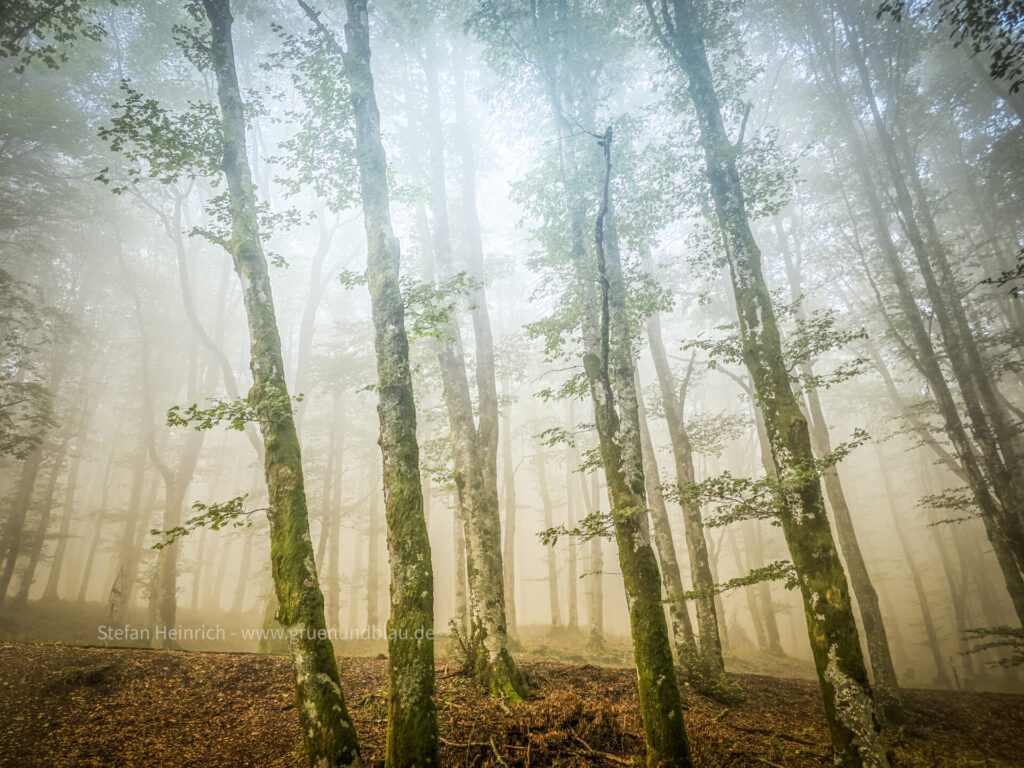
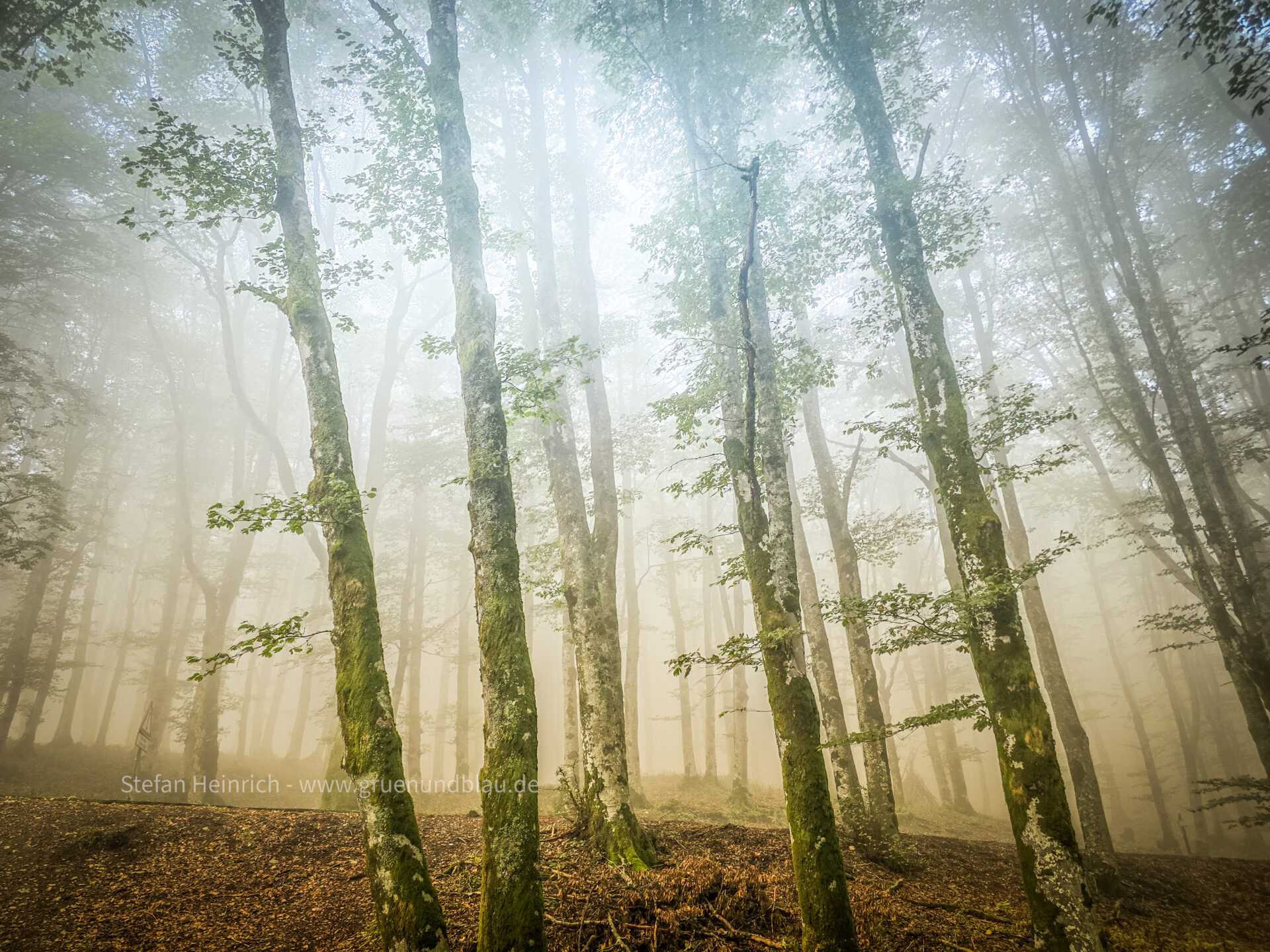
Monks, Mosquitoes, and the Heavenly Ladder: A Retreat into Camaldoli The narrow, steep mountain road wound turn after turn through dense forests, climbing up to the Sacro Eremo di Camaldoli. I needed this escape. After all the hustle and bustle of the cities, the constant drone of voices, and the crowds of tourists, my brain was craving the absolute silence of a hermitage. But upon arrival, disappointment struck: the courtyard was buzzing with day-trippers. So I laced up my hiking boots and fled straight into the solitude of the mountains. The forest greeted me with cool, damp autumn air. A carpet of wet leaves muffled every step, while a swarm of ravenous mosquitoes pursued me relentlessly. Yet, the atmosphere captivated me instantly: the towering firs and ancient beech trees, with their moss-covered, twisted trunks, looked strangely ghostly—as if guarding ancient secrets. I couldn’t get enough of the bizarre silhouettes standing like phantoms in the damp mist. Eventually, I found a mossy stone off the beaten path. I sat down to catch my breath and pulled out my notebook to read the story of this mystical place. In the year 1012, Saint Romuald retreated into these wild woods. Legend has it that a local count named Maldolo had a vision: he saw monks clad in snow-white robes ascending a dazzling ladder straight into heaven—on the very clearing of his estate. Moved by this vision, Count Maldolo gifted the mountain to the hermit (Ca’ Maldoli—the House of Maldolo). Romuald went on to build five tiny, strictly separated cells where the monks lived in absolute silence. I looked up. The rustling of the branches above suddenly sounded like the whispers of those ancient hermits, and the foggy forest seemed to swallow the centuries in the blink of an eye.
Montserrat Monastery – The Accounting of Heaven

Montserrat Monastery – The Accounting of Heaven We need to talk about parking ticket machines for a second. There are those days in vanlife when everything goes like clockwork. And then there are Tuesdays at the foot of Montserrat. I was standing in front of the barrier to the day-use parking lot in my yellow postal van, the line behind me was growing impatient, and the bulky metal monster of a pay station steadfastly refused to accept my credit card. “Card invalid,” flashed the pixelated display. I sighed. “Come on, pal. I just want to park under these jagged rocks for a few hours, stretch my legs, and maybe figure out why people have been pilgriming up this mountain for a thousand years.” I slapped the flat of my hand against the metal side panel. A hollow clang echoed through the cool mountain air. I gave the machine a bit of a shake by the card slot—just the usual, expert persuasion tactic every driver knows by heart. A nasty, high-pitched hum kicked in. The display started flickering wildly, throwing out hieroglyphs followed by an error message that was definitely not written in Spanish or Catalan: “Error 0x880: Temporal Loop Activated.” “What the…?” Before I could finish the thought, reality snapped shut like an old rubber band. The chug of my van’s diesel engine went silent. The smell of exhaust fumes and damp pine needles was abruptly replaced by the pungent stench of unwashed wool, cold candle wax, and very old cheese. I blinked. The parking lot was gone. My postal van was gone. I was no longer standing in front of a parking barrier, but right in the middle of a drafty, gloomy room with thick stone walls. Seated before me at a massive oak table were three men, illuminated by the meager glow of two smoking tallow candles. They were dressed in heavy cloth and long robes, staring at me in complete shock. “Where… where’s the scanner slot?” I stammered, pulling my blue cap low over my face as I tried to process the situation rationally. Perhaps that wasn’t cinnamon in my morning oatmeal, but hallucinogenic mushrooms. Or maybe the Catalan heat had finally fried my brain once and for all. “Who are you, stranger?” called out the man in the middle. He wore a slightly lopsided bishop’s miter and held a half-eaten chicken leg like a scepter. “And what is that strange blue headpiece? Is that some sort of heresy from Zaragoza?” “I… I just wanted to pay ten euros,” I said cautiously. “Ten euros?” chimed in the man to his left. He was as thin as a dried prune and sat behind a rather modest pile of silver coins. “What is a euro? Does that sound like hard currency? If so, hand it over! The Diocese of Manresa is broke!” I blinked again. Manresa? Broke? Bishop? The bishop sighed deeply, forgot about me for a moment, and gestured dramatically with the chicken bone in the air. “We have a hole in our budget bigger than the gorges of that blasted mountain behind us! The peasants pay their tithes in rancid butter, the merchants bypass our toll bridges, and the Pope is threatening to strip my miter if we don’t fix the cathedral roof soon. Berenguer, tell me we still have gold!” The thin man—obviously the Minister of Finance—shook his head mournfully and flicked the small wooden chest in front of him. It gave off a depressingly hollow sound. “Nothing, Your Eminence. Unless we conjure up a miracle within the next month, we’ll have to run the Mass on a shoestring budget and dilute the communion wine.” “A miracle…” muttered the third man in the group. He had well-groomed hands, a clever glint in his eye, and was unrolling a sheet of parchment. He was, without a doubt, the medieval PR manager. “We don’t need a small miracle. A healing spring won’t get any peasant to part with their coin these days. People want the whole package: lights, music, untouchable mysticism!” I leaned carefully against the cold stone wall. Okay, pep talk to my brain: Either you just collapsed on the asphalt and are dreaming the biggest nonsense of your life, or you are witnessing the birth of one of Europe’s greatest legends. “Listen here,” the PR specialist said, snapping his fingers with enthusiasm. “We take a few shepherd kids. They’ll believe anything if you promise them a loaf of bread. We send them to the foot of Montserrat on a Saturday evening. We hide a few men in the bushes to wave torches and play the flute.” “Flute?” the bishop asked skeptically. “You think that will convince the masses?” “Angelic singing, Your Eminence!” the PR man corrected with a broad grin. “We’ll call it heavenly melodies. The kids will run to the village, raving about the light and the voices. The following Saturday, you, the Bishop of Manresa, show up in full regalia. We pretend to find a carved statue of the Virgin Mary in a cave.” The Finance Minister perked up. His eyes turned greedy. “And then? How do we monetize that?” “Simple, Berenguer! We act as if we’re going to carry the statue to Manresa. But after just ten yards, you stop, contort your face in pain, and cry out: ‘Alas! She has grown as heavy as the mountain itself!’ We claim the Holy Virgin refuses to leave Montserrat. She WANTS to stay right here!” The bishop slammed his fist onto the table so hard the candles wobbled. “Brilliant! If the statue won’t come to the faithful, the faithful must come to the statue! We’ll build a chapel! No, a monastery! We’ll charge road tolls, sell devotional items, burn candles for cash, and later we’ll even get the city of Florence to pay for the lamp oil!” “Brilliant,” whispered the Finance Minister, tears of emotion welling up in his eyes. “It will fill the treasury for centuries! A marketing masterpiece!” They grinned at each
Lleida – The Shadow Over the Porta dels Apòstols
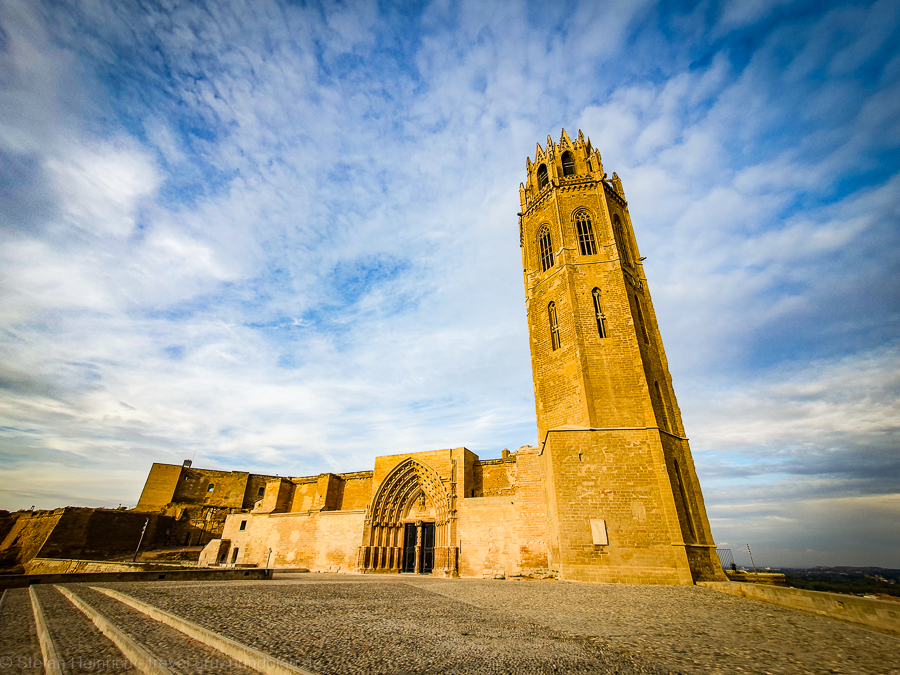
Lleida – The Shadow Over the Porta dels Apòstols The hot afternoon sun beat down mercilessly on the alleyways of Lleida, but I had no intention of breaking a sweat on my way up to the mighty Seu Vella cathedral. And why should I? Spain is the promised land for anyone who wants to conquer steep old-town hills without a single drop of perspiration on their brow. A low, metallic hum announced the urban luxury ahead: the city’s outdoor escalators. As the steps glided smoothly beneath me, carrying me meter by meter up the castle hill, I offered a silent prayer of thanks to Lleida’s visionary city architects. There is hardly anything more elegant than floating upward with hands in pockets, gliding past panting pedestrians, and watching the massive sandstone walls of the cathedral gradually emerge from a sea of rooftops. Reaching the top, I strolled over to the Porta dels Apòstols, the imposing main portal. Even from a distance, I could hear a resonant, well-trained voice. A tour guide, cloaked in the absolute authority of his office, stood with an index finger raised before a cluster of tourists who hung spellbound on his every word. I inconspicuously adjusted my pace, crossed my arms, and casually slipped into the outer edge of the group like a paying guest. The guide paused before a particularly ornate niche and dramatically lowered his voice: “Look upon these stones, senyores y senyores! The year is in the 14th century. The great master stonemason Bartomeu has been commissioned to create this portal. Years of his life were poured into the figures of the Apostles, but when it came to his masterpiece—the recess in the arch and the statue of the Virgin Mary—his luck ran out. His hands grew heavy, his mind weary. The figure remained stiff, cold, unfinished. Eventually, his young apprentice secretly took up the tools. In just a single night, driven by divine inspiration, the youth carved the face of the Madonna. When Bartomeu stepped onto the scaffolding the next morning, he couldn’t believe his eyes. It was a figure of such incomprehensible, flawless beauty that the stone itself seemed to breathe. But instead of awe, dark bile welled up inside Master Bartomeu. Envy consumed his heart. He could not bear the thought of being outshone by his own student. In a blind rage, he grabbed his heaviest mallet and struck the youth full in the face. The apprentice reeled, lost his footing, and plunged from the highest scaffolding to his death on these very cobblestones before the eyes of the horrified onlookers.” The guide took a well-calculated dramatic pause. But while the group murmured in awe, he slowly turned around. His gaze locked onto me. Throughout his entire monologue, he had been casting subtle, disapproving glances in my direction. It certainly hadn’t escaped his notice that I had joined his paying audience without contributing a single cent for a ticket. Now he saw his chance to humiliate the free-rider in front of everyone. He offered me a condescending, smirk-laden smile, pointed his index finger at me, and spoke loudly enough for even the last person in line to hear: “Well now… I must say, in my career I have certainly had better listeners than this gentleman here in the blue cap!” A few heads turned toward me with amused grins. The group waited for my embarrassment. But I didn’t so much as blink. I stepped half a pace forward, calmly tipped the brim of my cap, and replied in a steady, carrying voice: “Well, my dear sir—and I have certainly heard better legends than this exact one. In fact, I already know it. Exactly three months ago, I heard it at a church in Vilnius, the capital of Lithuania. There, too, it just so happened to be the very last stone on the facade that the apprentice carved far better than his master. And there, too, the master pushed the poor boy off the scaffolding out of pure envy.” I paused briefly to let the sentence hang in the air, then added with a smile: “Looks like stonemasons across medieval Europe had the exact same little PR problem.” A loud snort broke the ice. First an older gentleman in the front row burst out laughing, and then half the group joined in with hearty laughter. The guide turned bright red in an instant. His condescending smile froze on his face. He cleared his throat hurriedly, glanced at his watch, and clapped his hands together: “Well then! Moving along to the cloisters, we have very little time!” With brisk steps, he herded his group away. I remained alone at the Porta dels Apòstols, leaning comfortably against the cool sandstone wall and enjoying the view over the city—secure in the knowledge that even without a ticket, you sometimes get the best entertainment.
Bardenas Reales and the Song of the Semi-Desert Wind: The Legacy of Sanchicorrota

Bardenas Reales and the Song of the Semi-Desert Wind: The Legacy of Sanchicorrota Traveling in an old yellow postal van comes with its own set of rules. It’s a slow, honest way to drive. But the moment you cross the border into the Bardenas Reales—that bizarre, surreal desert of clay and sandstone in southern Navarre—the road abruptly transforms into a track of deep potholes, loose gravel, and fine, yellowish dust. I sat behind the wheel of my van-colossus, both hands gripping the steering wheel tightly as the vehicle crept step by step across the dried-up moonscape. Walking pace. The jagged terrain allowed for nothing more, unless you were willing to sacrifice your suspension on the altar of the semi-desert. There was not another soul in sight. No fellow vanlifers, no day tourists, not even a stray dog. Just the endless wasteland of deeply eroded canyons, dry riverbeds, and the sharp silhouettes of the cabozos—those mesa mountains jutting out of the earth like gigantic sculptures. And then there was the wind. It didn’t just blow; it ruled. The Cierzo, that notorious, ice-cold katabatic wind from the Ebro Valley, swept over my postal van, rattling its doors. It lifted thin veils of ocher dust from the earth and made the vehicle sway with a steady, menacing regularity. The deeper I ventured into the heart of the Bardenas, the louder the whistling became against the window seals. Eventually, I reached the icon of this no-man’s-land: Castildetierra. Rising sharply into the steel-blue sky like a massive pyramid sculpted by wind and weather, the clay pinnacle stood as a monument to transience, carved by millennia of erosion. I turned off the engine. The sudden silence inside the van lasted only a heartbeat before the wind began drumming against the bodywork. I took a deep breath, opened the driver’s door, and stepped out into the desert. The wind hit me like a physical force. It tugged at my jacket, roared in my ears, and whipped up sand that stung softly against my skin. Yet as I walked closer to the base of Castildetierra and let my eyes trace up the steep flank of the rock needle, the uproar shifted. The untamed howling of the Cierzo, caught in the fissures and caves of the jagged earth, acquired a melody. It became a rough, throaty, whispering frequency that seemed to rise not from the air, but directly out of the stone. When you drive alone in the silence for hours, your mind can play tricks on you. But in that moment, I was certain: the wind of the Bardenas was speaking to me. It whistled through the hollowed rock faces, and within its multi-layered hiss, words began to form. An ancient voice, weathered by sand, began to weave its tale: “Do you hear me, stranger on your four wheels? You drive slowly, yet you are not the first to seek refuge here from the eyes of the world. Five hundred years ago, this land belonged to no king, no bishop, and no army. It belonged to me. Sancho Rota was my name. But history calls me Sanchicorrota—the King of the Bardenas!” The wind blew sharper, spinning a spiral of dust directly at my feet, and the voice within the howl grew stronger, almost defiant: “Look at it, the mighty rock of Castildetierra! In its shadow and in the deep caves beneath your feet, my heart once beat. I was no ordinary thief. The rich, the proud merchants of Zaragoza and Tudela, trembled whenever they had to cross the desert. With my thirty loyal men, we lay in wait for them in the ravines. Gold, silk, grain—we took it from the sated. But we did not keep it for ourselves. We brought it to the starving shepherds and impoverished peasants of the Bardenas. To the Crown, I was a demon; to the people, a savior!” I zipped my jacket up to my chin. The wind blew so hard that tears welled in my eyes, but I couldn’t tear my gaze away from Castildetierra. It was as if the shadow of the bandit king were taking shape right against the rock face. “Do you know how to survive in a desert where two hundred knights are hunting you?” the Cierzo hissed softly and mischievously, as if whispering a secret into my ear. “Through cunning! Whenever the soldiers of King Juan II searched for my tracks in the dust, they found them. But the tracks never led to me—they led away from me! I had the horseshoes of my men’s horses nailed on backward! The fools followed the prints for miles in the wrong direction, while we sat behind their backs in the shadow of Castildetierra, laughing and drinking their wine.” A sudden gust of wind ripped at the hem of my hood, loud and cracking like a gunshot. “Yet no king tolerates a second ruler in his realm,” the voice boomed darker now, carried by a low, rumbling howl that vibrated through the canyons. “In March of 1452, they had had enough. The king sent an army. Over two hundred knights surrounded the Bardenas. They occupied every spring, every pass, every cave. There was no escape. They drove me here, to the foot of this rock.” For a brief, suffocating moment, the wind seemed to stand completely still. Not a grain of dust moved. The silence was as heavy as lead. “They wanted to take me to the gallows. They wanted to see my head on a pike to humiliate the people. But Sancho Rota bows his knee to no king! As the knights’ armor gleamed in the sun and the circle tightened, I drew my own dagger. One strike to my own heart—fast, cold, and free. I gave my life to the desert, but never my freedom!” A tremendous gust crashed through the clay ravines like a strike on a kettledrum. Dust swirled high, shrouding Castildetierra in an impenetrable yellow veil, turning the roar of the Cierzo into
The Conclave of the Wordsmiths: A Midday Rest at Dante’s Tomb

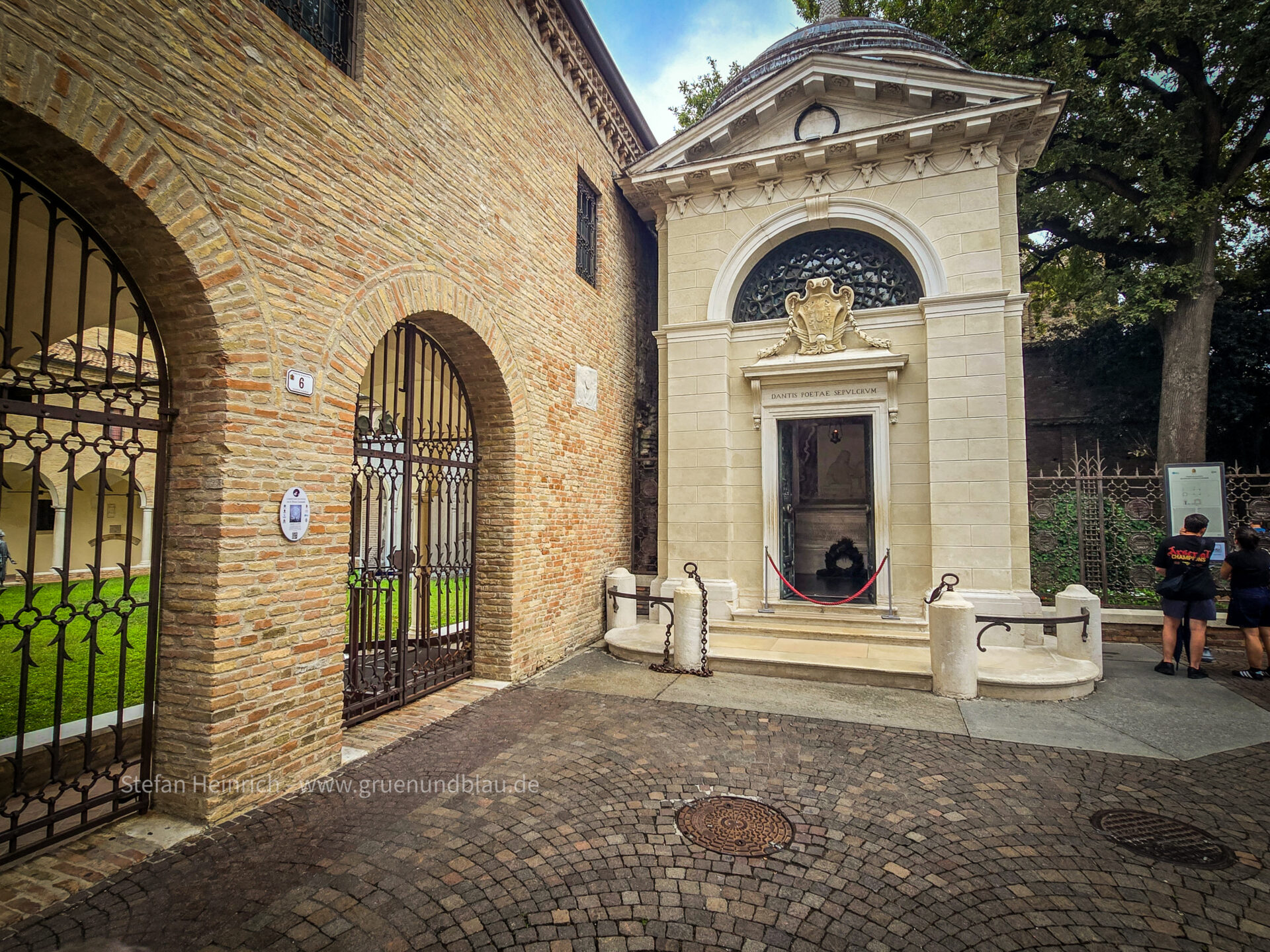
The Conclave of the Wordsmiths: A Midday Rest at Dante’s Tomb Traveling makes you tired. Especially after wandering through the cobblestone labyrinth of Ravenna for hours, marveling at mosaic after mosaic, as the cool Adriatic breeze gradually gives way to a oppressive afternoon sun. After my detour to the Tomba di Dante—the simple, white mausoleum where Italy’s greatest poet prince found his seemingly infinite rest—I needed a break. I snapped a few more photos of the burning oil lamp, whose fuel is donated to this day by the city of Florence as a symbolic act of penance, and slipped around the back of the building. On the backside of the tomb, I found a shady spot on an old brick wall warmed by the sun. I rested my head against the cool masonry, let my camera slide onto my lap, and closed my eyes for a brief moment. The quiet murmur of passersby, the peaceful cooing of pigeons, and the warm air instantly lulled me into a state between waking and dreaming. Suddenly, the atmosphere shifted. The sounds of the modern city—the clatter of plastic soles, the whir of e-scooters—seemed to evaporate behind a thick, invisible wall. Instead, a rhythmic, solemn rustle of heavy fabric met my ears, accompanied by deep, measured voices. I didn’t open my eyes completely. Through my eyelashes, blurred by the glare of the blazing sun, I perceived four figures standing directly beside me in the shadow of the monastery wall. They were entirely out of time. Not tourists in functional outdoor gear, but men in flowing, heavy robes, lace collars, and dark cloaks swaying gently in the light breeze. “Unbelievable,” rumbled a rough, deep voice in German that sounded like the Thuringian Forest, ink, and old parchment. “Another whole year has passed since we last gathered at this place.” “Time in the afterlife flows like the Arno in late summer, my dear Martin,” replied a melodious, unmistakably Italian voice full of pride and melancholy. “Yet as long as my flesh rests in this earth and my spirit hovers above the songs of humanity, this place remains our sanctuary.” I held my breath. I couldn’t believe my eyes and ears, yet I didn’t dare move for fear of driving the vision away. “Ah, Signor Alighieri,” a third voice chimed in, its sentence structure steeped in fine Spanish irony and the soft cadence of Castile. “You Italians always lean toward the dramatic. But you are right. We are not here to mourn over the ashes of the past, but to celebrate the Word. Look at these people walking by over there. They speak, they curse, they write poetry—and they have no idea who handed them the tools to do so.” The fourth man, draped in a fine English ruff collar, stepped forward. His gaze was wild, filled with poetry and razor-sharp powers of observation. “They use our phrases without knowing our names, my dear Miguel,” he murmured in Elizabethan English that nonetheless seemed understandable to everyone. “To be or not to be—they carry our thoughts on their tongues as if they were their own. We did not merely give them words; we created their world.” There it stood—the most incomprehensible gathering in world literature. Dante Alighieri, the father of the written Italian language, who tore Tuscan from the shackles of the Latin monopoly and shaped the soul of an entire nation with his Divine Comedy. Martin Luther, who listened to the common folk, translated the Bible, and bestowed upon the German language its very first shared grammar and visual imagery. Miguel de Cervantes, who created the modern Spanish language with his knight of the woeful countenance, Don Quixote, and changed humanity’s sense of humor forever. And William Shakespeare, who wove thousands of new terms into the English language and fathomed the human psyche deeper than anyone before or since. “Consider what we have done,” Luther spoke, clenching a powerful fist. “We found dialects—a chaos of fragments! People could barely understand one another from one village to the next. We reached into the mud of everyday speech and molded it into iron and gold. I chose the language of the simple man to let God Himself speak.” “And I chose the language of Hell, Purgatory, and Paradise,” Dante countered, his sharp profile glowing in the sunlight. “I showed them that the vernacular—the Volgare—is capable of bearing the highest peaks of philosophy and the deepest abysses of the human soul. Florence banished me, yet my language united all of Italy!” Cervantes chuckled softly, a dry, wise laugh. “We gifted them their reason, Dante. I gave Spaniards madness and sanity in a single breath. Don Quixote and Sancho Panza—through their dialogues, an entire nation learned how to doubt, hope, and love. We didn’t just invent words. We forged the identity of millions of souls.” “We are the architecture of their thought,” Shakespeare added, looking up at the clear blue sky over Ravenna. “Every time a lover swears an oath, every time a tyrant hesitates, every time a human asks for forgiveness—they walk the paths we cleared through the thicket of the human mind. Our bodies are dust, but our language is immortal.” The four giants stepped closer together. They laid their hands on one another’s shoulders—a silent, centuries-old alliance of wordsmiths who had laid the foundation of the modern world. Their figures began to glow in the harsh afternoon light, while the names Dante, Luther, Cervantes, Shakespeare echoed like a sublime chant between the ancient bricks of the monastery wall. The light grew brighter and brighter, the contours of their mythical cloaks beginning to shimmer and blur— “WOOF! WOOF!” A shrill, feisty bark ripped me violently out of my half-sleep. I jolted awake, sat bolt upright, and rubbed my eyes frantically. Directly in front of my wall stood a small, brown mixed-breed dog on a leash, barking at me excitedly. His owner—an elderly lady carrying a shopping bag—smiled at me apologetically. “Scusi, signore! He didn’t mean to startle you.”
The Secret in the Stone: Why Ravenna’s Sarcophagi Are Better Left Unbroken

The Secret in the Stone: Why Ravenna’s Sarcophagi Are Better Left Unbroken Traveling in a van sharpens your eye for life’s peculiar details. As I strolled through the historic center of Ravenna and turned onto Piazza San Francesco, I could hardly believe my eyes. There they stood: massive, ancient stone sarcophagi made of the finest marble, sitting completely unabashed out in the open, directly in front of the old basilica’s facade. No velvet ropes, no museum guards—just tons of Late Antiquity colossi that time had been gnawing on for over fifteen hundred years. Just as I was about to step closer to inspect the intricate carvings along the edges, the sky opened its floodgates. A classic Northern Italian downpour set in. I grabbed my folding bike, Rocinante, pushed it quickly under the protective arcade on the edge of the square, and shook the rain out of my hair. Under the shady arches, I wasn’t alone. A small group of local men stood in a circle, elbows resting casually against the masonry. In front of them sat an impressive collection of green beer bottles. Knock-off time in the historic heart of town. They were talking loudly with animated hand gestures about soccer and the weather. I took the opportunity, stepped closer with a broad grin, and gestured with my thumb over my shoulder at the drenched giants outside in the rain. “Say, guys,” I called out to them in a mix of Spanish and Italian, “are those out there in the coffins maybe your former colleagues who had a bit too much of your homebrew? Or why are you parking the dead right in the middle of the square?” The men paused. A few seconds of silence followed, and then one of them—an older guy with unruly gray hair and tanned skin—burst into a deep, throaty laugh. “Former colleagues! That’s a good one, amigo!” he shouted, taking a big gulp from his bottle and waving me over. “No, no. In there lies old-school royalty. But if you think the sarcophagi out here are strange, you haven’t heard the story of Empress Galla Placidia yet. That one will teach you a thing or two about fire and stone!” He leaned his back against the wall, held his bottle like a scepter, and began telling the story in a dramatic voice: “You have to know that back in the 5th century, Ravenna was the capital of the entire Western Roman Empire. An Empress named Galla Placidia ruled here—a woman of incredible power, wealth, and beauty. When she died, they built her the most magnificent mausoleum, which you can find right around the corner. Inside stand three gigantic, plain marble sarcophagi. “But folklore has been telling the true story of her sarcophagus for centuries: Galla Placidia wasn’t simply laid flat inside like any ordinary mortal. No! They seated the Empress on a massive, fragrant cedar throne, draped her in the heaviest robes woven with pure gold, placed a crown on her head, and sealed the mighty stone tomb. She was meant to reign like a ruling queen in her dark stone chamber for all eternity. “So that posterity could witness this wonder, the stonemasons carved a tiny peephole into the thick marble. For centuries, people came from far and wide. They would approach the sarcophagus, hold a burning candle close to the little hole, and peer inside. And indeed: in the faint glow of the candlelight, you could see the preserved figure of the Empress sitting mute and sublime upon her throne, while the gold of her garments glittered in the dark. “It went well for over a thousand years. Until the fateful year of 1577. “On a damp, cold afternoon, a curious little local boy sneaked into the mausoleum. He desperately wanted to see the famous dead Empress. But the boy was small, the hole was narrow, and the darkness inside the tomb was deep. To see better, he didn’t just hold his burning candle in front of the hole—he pushed it deep inside the cavity of the sarcophagus. “A fatal mistake. The flame touched the centuries-old, bone-dry silk robes of the Empress. Within seconds, a devastating draft caught. The dry-preserved wood of the throne and the precious fabrics caught fire in a flash. The boy screamed and dropped the candle. The cavity of the marble tomb turned into a glowing furnace. By the time the monks came rushing in, black smoke was already billowing from the little hole. “When the fire finally burned out and the smoke cleared, they looked through the charred hole inside: the throne, the robes, the crown, and the Empress herself were completely consumed. Nothing was left—except a handful of gray ash on the cold floor of the stone sarcophagus.” The man paused, took a final sip from his beer bottle, and looked at me intently. “Ever since, the Empress’s sarcophagus has been completely empty. And the moral of the story? Keep your hands off old stone coffins—especially when you’re carrying fire!” The other men nodded in agreement and laughed. The narrator slapped my shoulder in a friendly, camaraderie-filled way, reached for a fresh, unopened beer from a crate on the floor, and held it out to me. “So, you strangely speaking Spaniard—or whatever you are! Let’s drink to that. Sit down with us, the rain’s gonna last a while!” I looked at the cold beer, looked over at the drenched stone colossi in front of the church—which almost looked like ancient monuments in the heavy rain—and shook my head with a chuckle. “Thank you so much for the invitation and the fantastic story,” I said with a grin as I zipped up my rain jacket. “But looking at your sarcophagi out there in the square… honestly, they seem a bit too densely populated for my taste! And before I end up carved in stone myself, I’d better hop back on my folding bike and keep riding through Italy.” The men hooted with laughter, toasted their bottles