







The Secret in the Stone: Why Ravenna's Sarcophagi Are Better Left Unbroken
Traveling in a van sharpens your eye for life’s peculiar details. As I strolled through the historic center of Ravenna and turned onto Piazza San Francesco, I could hardly believe my eyes. There they stood: massive, ancient stone sarcophagi made of the finest marble, sitting completely unabashed out in the open, directly in front of the old basilica’s facade. No velvet ropes, no museum guards—just tons of Late Antiquity colossi that time had been gnawing on for over fifteen hundred years.
Just as I was about to step closer to inspect the intricate carvings along the edges, the sky opened its floodgates. A classic Northern Italian downpour set in. I grabbed my folding bike, Rocinante, pushed it quickly under the protective arcade on the edge of the square, and shook the rain out of my hair.
Under the shady arches, I wasn’t alone. A small group of local men stood in a circle, elbows resting casually against the masonry. In front of them sat an impressive collection of green beer bottles. Knock-off time in the historic heart of town. They were talking loudly with animated hand gestures about soccer and the weather.
I took the opportunity, stepped closer with a broad grin, and gestured with my thumb over my shoulder at the drenched giants outside in the rain.
“Say, guys,” I called out to them in a mix of Spanish and Italian, “are those out there in the coffins maybe your former colleagues who had a bit too much of your homebrew? Or why are you parking the dead right in the middle of the square?”

The men paused. A few seconds of silence followed, and then one of them—an older guy with unruly gray hair and tanned skin—burst into a deep, throaty laugh.
“Former colleagues! That’s a good one, amigo!” he shouted, taking a big gulp from his bottle and waving me over. “No, no. In there lies old-school royalty. But if you think the sarcophagi out here are strange, you haven’t heard the story of Empress Galla Placidia yet. That one will teach you a thing or two about fire and stone!”
He leaned his back against the wall, held his bottle like a scepter, and began telling the story in a dramatic voice:
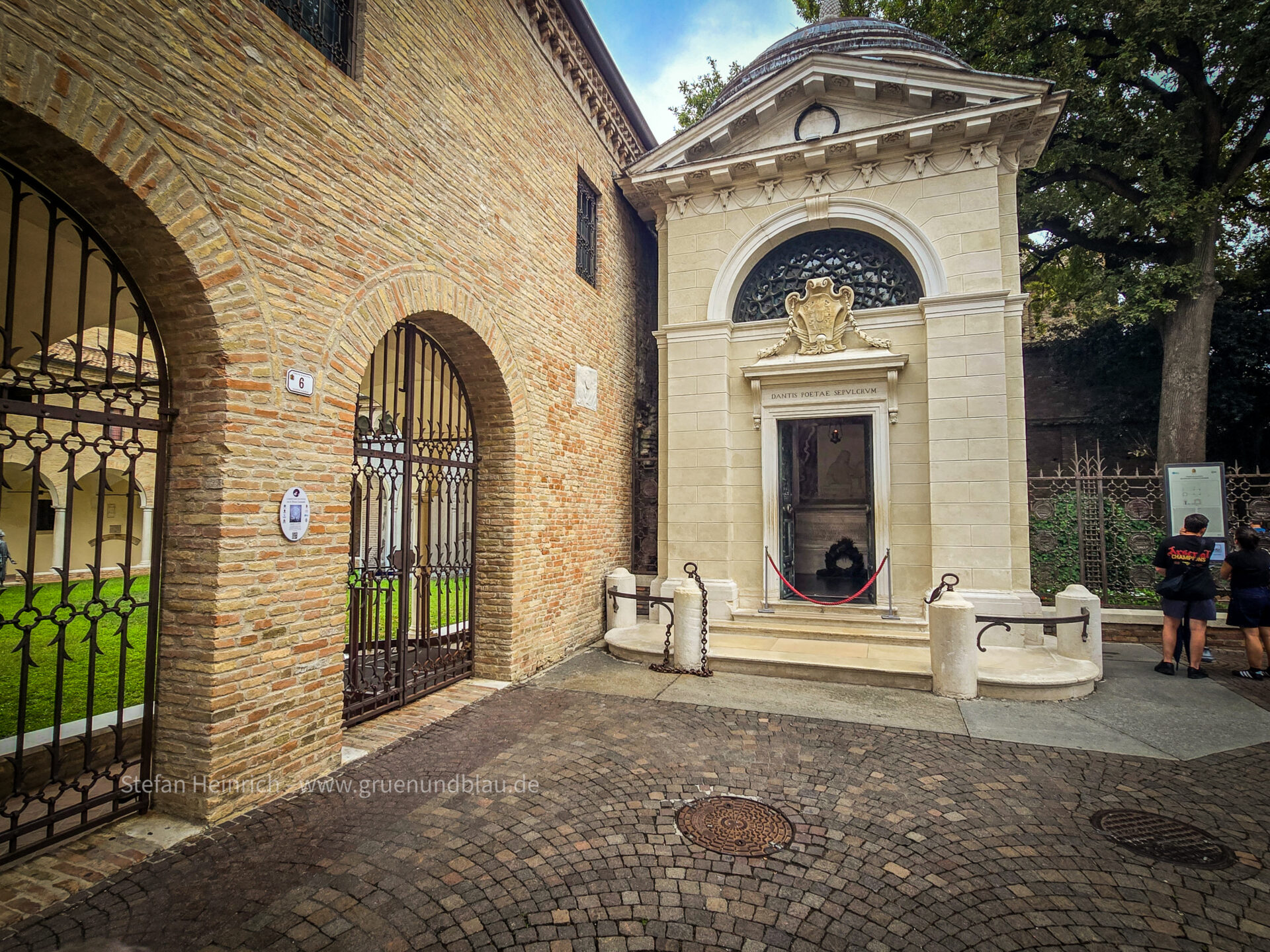
“You have to know that back in the 5th century, Ravenna was the capital of the entire Western Roman Empire. An Empress named Galla Placidia ruled here—a woman of incredible power, wealth, and beauty. When she died, they built her the most magnificent mausoleum, which you can find right around the corner. Inside stand three gigantic, plain marble sarcophagi.
“But folklore has been telling the true story of her sarcophagus for centuries: Galla Placidia wasn’t simply laid flat inside like any ordinary mortal. No! They seated the Empress on a massive, fragrant cedar throne, draped her in the heaviest robes woven with pure gold, placed a crown on her head, and sealed the mighty stone tomb. She was meant to reign like a ruling queen in her dark stone chamber for all eternity.
“So that posterity could witness this wonder, the stonemasons carved a tiny peephole into the thick marble. For centuries, people came from far and wide. They would approach the sarcophagus, hold a burning candle close to the little hole, and peer inside. And indeed: in the faint glow of the candlelight, you could see the preserved figure of the Empress sitting mute and sublime upon her throne, while the gold of her garments glittered in the dark.
“It went well for over a thousand years. Until the fateful year of 1577.
“On a damp, cold afternoon, a curious little local boy sneaked into the mausoleum. He desperately wanted to see the famous dead Empress. But the boy was small, the hole was narrow, and the darkness inside the tomb was deep. To see better, he didn’t just hold his burning candle in front of the hole—he pushed it deep inside the cavity of the sarcophagus.

“A fatal mistake. The flame touched the centuries-old, bone-dry silk robes of the Empress. Within seconds, a devastating draft caught. The dry-preserved wood of the throne and the precious fabrics caught fire in a flash. The boy screamed and dropped the candle. The cavity of the marble tomb turned into a glowing furnace. By the time the monks came rushing in, black smoke was already billowing from the little hole.
“When the fire finally burned out and the smoke cleared, they looked through the charred hole inside: the throne, the robes, the crown, and the Empress herself were completely consumed. Nothing was left—except a handful of gray ash on the cold floor of the stone sarcophagus.”
The man paused, took a final sip from his beer bottle, and looked at me intently. “Ever since, the Empress’s sarcophagus has been completely empty. And the moral of the story? Keep your hands off old stone coffins—especially when you’re carrying fire!”
The other men nodded in agreement and laughed. The narrator slapped my shoulder in a friendly, camaraderie-filled way, reached for a fresh, unopened beer from a crate on the floor, and held it out to me.
“So, you strangely speaking Spaniard—or whatever you are! Let’s drink to that. Sit down with us, the rain’s gonna last a while!”
I looked at the cold beer, looked over at the drenched stone colossi in front of the church—which almost looked like ancient monuments in the heavy rain—and shook my head with a chuckle.
“Thank you so much for the invitation and the fantastic story,” I said with a grin as I zipped up my rain jacket. “But looking at your sarcophagi out there in the square… honestly, they seem a bit too densely populated for my taste! And before I end up carved in stone myself, I’d better hop back on my folding bike and keep riding through Italy.”
The men hooted with laughter, toasted their bottles to my health, and I pedaled off in high spirits through the easing summer rain.